
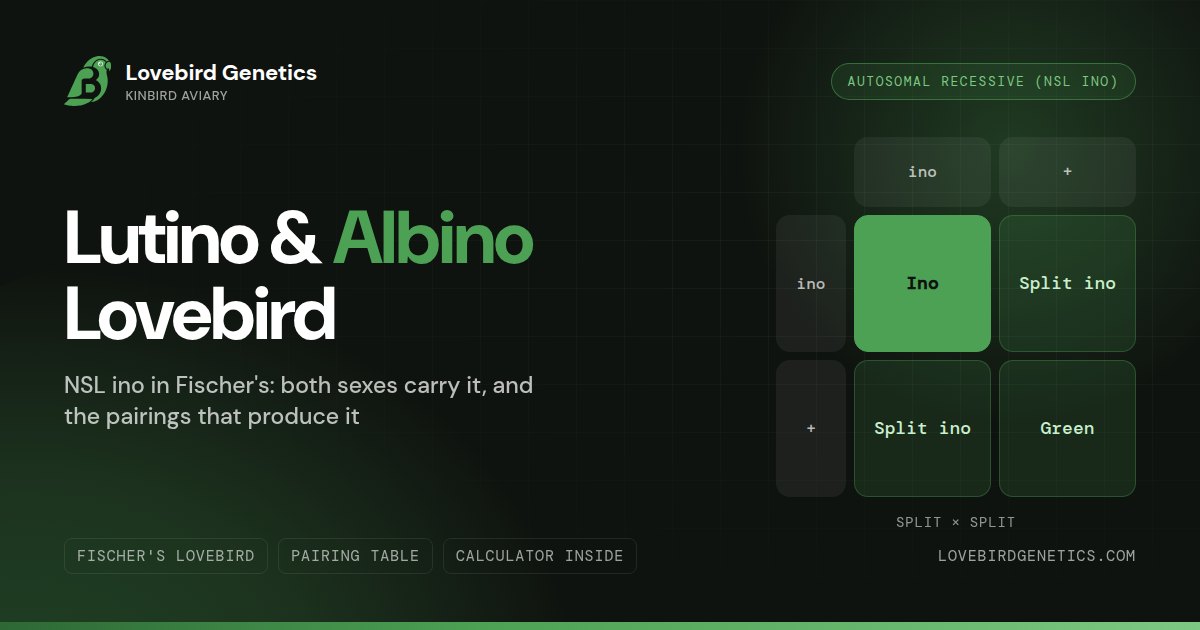
Lutino Fischer's lovebirds are autosomal recessive Ino birds on a green base, bright yellow with a red-orange face and red eyes. Albino is Ino on a Blue base, pure white with red eyes. The Ino mutation eliminates almost all eumelanin through deformed melanosomes, giving the characteristic bright-red eye. In Fischer's lovebirds, Ino is autosomal recessive, both males and females can be splits, unlike cockatiels or budgerigars where Ino is sex-linked.
Ino removes almost all eumelanin: Lutino is the green-series ino (red eyes, bright yellow body) and Albino is the blue-series ino (pure white). Van den Abeele documents two independent ino mutations in lovebirds, sex-linked ino (pp. 386 to 395) and non-sex-linked ino (pp. 344 to 359); they look nearly identical but inherit differently, which is why parentage records matter (Lovebird Compendium).
What is the Ino mutation?
The Ino mutation in lovebirds removes almost all eumelanin, leaving the yellow and structural colours behind. On a green bird this gives Lutino (bright yellow, orange mask, red eyes); on a blue bird it gives Albino (pure white, red eyes). In this calculator it is modelled as autosomal recessive.
Ino leaves the melanosomes deformed. Melanosomes are the cellular structures that synthesise and deposit melanin, and when they are malformed they cannot synthesise or transport eumelanin properly. The result: almost all eumelanin pigment is removed from the feathers, skin, and eyes. No causal gene has been published for the non-sex-linked ino of Agapornis fischeri, so the melanosome mechanism, rather than a gene name, is what breeders should work from.
What remains is only the psittacine pigment, the yellow and red pigments that birds produce through a completely separate pathway. These are unaffected by the Ino mutation. The red eyes are a direct result of the melanin-free iris revealing the underlying blood vessels.
Lutino = Ino mutation on a green base. The green base has yellow psittacine, so the bird appears all yellow (sometimes with faint orange on the face) with red eyes.
Albino = Ino mutation on a blue base. Blue lovebirds lack psittacine pigment, so with melanin also removed, only white feathers remain. Red eyes.
How Ino works, in plain terms
Ino removes almost all eumelanin, leaving the bird's yellow and structural colours behind. On a green bird that gives Lutino, bright yellow with an orange mask and red eyes; on a blue-series bird it gives Albino, pure white with red eyes. The red eyes come from the same loss of melanin inside the eye. Van den Abeele documents two ino mutations in lovebirds: non-sex-linked ino (autosomal recessive, pp. 344 to 359), the form this calculator models, and sex-linked ino (pp. 386 to 395). They look nearly identical but inherit differently, so knowing your line matters.
One more thing that trips up new Ino breeders: Ino does not sit at the locus alone. DEC (Dark Eyed Clear) and Pastel are alleles of the same NSL ino a-locus as Ino itself, which means a single bird can hold at most two of the four. That is why you see compounds written as DEC / Ino and Pastel / Ino, where the double slash marks two different alleles of one gene rather than a split. Because the locus is autosomal, both cocks and hens can be splits and both can be compounds.
Autosomal recessive, not sex-linked
In Agapornis fischeri, Ino is autosomal recessive, not sex-linked. This is the reverse of cockatiels and budgerigars, where Ino sits on the Z chromosome. Because the lovebird Ino gene is autosomal, both cocks and hens can be split, a hen can carry it invisibly and pass it to either sex, and a visual Lutino can be either male or female. Do not import the sex-linked Ino logic of other parrots, and never assume a visual Lutino lovebird is a hen (Van den Abeele, Lovebird Compendium, 2016).
In Agapornis fischeri, the Ino gene is not carried on a sex chromosome. It sits on an autosome, a non-sex chromosome, and behaves as standard autosomal recessive. This has two critical consequences:
- Both males and females can be splits. A female can carry one copy of Ino without showing it, and pass it to half her offspring. This is impossible in species where Ino is sex-linked.
- No auto-sexing from Ino in Fischer's. Since females can be splits, you cannot use Ino offspring to determine sex the way you can with sex-linked mutations like Opaline.
Breeders experienced with cockatiels or budgerigars sometimes assume Ino is sex-linked in all parrots. In Fischer's lovebirds it is not. Do not apply cockatiel or budgerigar Ino rules to your Fischer's pairings, the inheritance pattern is different.
Core Ino pairings
| 1.0 Lutino (Visual Ino)0.1 Normal (pure) | ||
|---|---|---|
| Offspring | Chance | Note |
| Normal / Ino (split) | 100% | All offspring are carriers, none show Lutino visually |
Use this pairing to introduce Ino into a new line. All offspring are confirmed splits, both male and female.
Try this pairing →| 1.0 Normal / Ino0.1 Normal / Ino | ||
|---|---|---|
| Offspring | Chance | Note |
| Lutino (Visual Ino) | 25% | Both male and female equally likely |
| Normal / Ino (split) | 50% | |
| Normal (pure) | 25% | |
| 1.0 Green / Blue / Ino0.1 Green / Blue / Ino | ||
|---|---|---|
| Offspring | Chance | Note |
| Albino (Visual Ino + Blue + Blue) | 6.25% | Both Blue and Ino must land homozygous at once, rare from double splits |
| Lutino (Visual Ino + Green base) | 18.75% | |
| Various splits and normals | 75% | Use the calculator for the full breakdown with your specific parent genotypes |
Both parents here are green birds carrying Blue and Ino invisibly. Two visual Blue parents cannot produce a green-series Lutino, which is why this table starts from green double splits. Albino requires the chick to be homozygous for both Blue and Ino. Use the calculator with your actual parent genotypes for precise percentages.
Try this pairing →| 1.0 Lutino (Visual Ino)0.1 Lutino (Visual Ino) | ||
|---|---|---|
| Offspring | Chance | Note |
| Lutino (Visual Ino) | 100% | All offspring are Lutino, the most efficient Lutino production pairing |
Once you have both a Lutino male and Lutino female, all offspring will be Lutino. There are no splits or normals, every chick in every nest shows the mutation.
Try this pairing →| 1.0 Lutino (Visual Ino)0.1 Normal / Ino (split) | ||
|---|---|---|
| Offspring | Chance | Note |
| Lutino (Visual Ino) | 50% | |
| Normal / Ino (split) | 50% | |
50% Lutino per clutch, a very productive pairing for established Ino lines. All non-Lutino offspring are confirmed splits (no pure normals).
Try this pairing →Identifying Lutino and Albino Fischer's lovebirds
Lutino and Albino Fischer's lovebirds are among the most visually distinctive mutations available, there is very little ambiguity in visual identification for experienced breeders, though beginners sometimes confuse Lutino with Pale Fallow or Dilute.
Lutino identification
- Plumage: All yellow body. The normal green areas become yellow; the face retains orange-red but often brighter. Wing feathers are white to cream where dark brown/black barring was present.
- Eyes: Distinctly red (deep burgundy-red). This is the most reliable single feature, no other Fischer's mutation produces red eyes in combination with yellow plumage except Lutino.
- Feet and beak: Pale pink feet and beak (no dark melanin pigmentation).
- At fledging: Lutino chicks are identifiable from the moment their pin feathers open, the absence of dark melanin is visible immediately. Eye colour confirms at day 1.
Albino identification
- Plumage: Pure white throughout. The blue base lacks psittacine pigment; Ino removes the remaining melanin, leaving only white.
- Eyes: Red (same as Lutino). White bird with red eyes is the definitive Albino signature.
- Rarity: Albino requires both Blue (homozygous) and Ino (homozygous). It is significantly rarer than Lutino and is in strong demand in most markets.
Lutino vs Pale Fallow vs Dilute
New breeders sometimes confuse these three because all produce lighter-coloured birds. The key distinction is eye colour:
- Lutino: Red eyes, always
- Pale Fallow: Light red eyes (paler, more orange-pink than true red), see Pale Fallow vs Dun Fallow →
- Dilute: Normal dark eyes, the bird is lighter but no eye colour change
How to confirm split Ino status
Because splits look completely normal, confirming split Ino status without DNA testing requires a test pairing. There are three methods:
Method 1, Pair with a known Lutino
Pair the suspected split with a confirmed Lutino. If any Lutino offspring appear, the parent is confirmed split. Expected result from a true split: 50% Lutino, 50% split. A pure normal paired with a Lutino produces 100% splits, zero Lutino offspring, which is indistinguishable from a split result in a single clutch unless you see Lutino chicks appear.
To distinguish split from pure normal via this method: you need to see at least one Lutino chick. If a full season produces zero Lutino offspring when paired with a Lutino, the bird may be a pure normal, but a single season is not conclusive (statistical chance of seeing zero from a split exists).
Method 2, Pair with another suspected split
If you have two birds you believe are splits (from pedigree records), pair them. If Lutino offspring appear (expected 25%), both are confirmed splits. No Lutino offspring in a single season does not rule out split status, with 4-6 chicks per clutch and 25% chance per chick, a split × split cross can produce zero Lutino chicks by chance in a small sample.
Method 3, DNA testing
The fastest and most reliable method. A blood sample or feather sample submitted to an avian genetics lab will definitively confirm Ino carrier status. Recommended for any bird where confirmed split status matters to a breeding plan.
Ino combined with other mutations
Because Ino removes almost all eumelanin, it interacts powerfully with mutations that modify the colour base:
- Ino + Aqua base, removes the dark melanin structure from an Aqua bird, leaving a very pale, near-white turquoise-yellow bird. Rare and striking.
- Ino + Opaline, Opaline's psittacine redistribution is visible on an Ino background, producing a bird with stronger yellow concentration on certain feather areas.
- Ino + Pale Fallow, two melanin-reducing mutations combined; produces an extremely pale bird. Viability can be lower in heavy melanin-reduction combinations.
The Ino Mutation, What It Does at the Cellular Level
Understanding what the Ino mutation actually does at the biological level helps explain every visual characteristic of Lutino and Albino birds, and clarifies why Ino interacts so distinctly with every other mutation.
The NSL Ino mutation in Fischer's lovebirds is documented as a TYR-positive melanin elimination mutation. This is a critical distinction: the Tyrosinase (TYR) enzyme is present and functional in Ino Fischer's lovebirds, unlike the TYR-negative full albinism of mammals, where the enzyme itself is absent. Instead, the Fischer's lovebird Ino mutation affects melanosomes, the organelles inside melanocyte cells that are responsible for producing and depositing melanin into feather barb cells.
In an Ino bird the melanosomes are structurally deformed. They cannot synthesise or transport eumelanin properly, even though the upstream TYR enzyme is functioning. The result is a near-total failure of eumelanin deposition in feathers, skin, and eyes, despite the enzymatic machinery technically being intact. The gene behind non-sex-linked ino in Fischer's lovebirds has not been published, so the melanosome mechanism is the honest description.
Because almost all eumelanin is eliminated but psittacofulvins are synthesised through a completely separate biosynthetic pathway (unrelated to TYR or to the melanosome route), a Lutino bird retains full orange-red face and yellow body. The feathers that would normally be green (a combination of yellow psittacofulvins with melanin structural colour) become pure yellow. The feathers that would be dark brown or black become white. Red eye colour results from the absence of melanin in the iris, which allows the underlying blood vessels to be visible through the depigmented iris tissue. (Reference: Van den Abeele, 2016, Lovebird Compendium.)
Lutino vs Albino, The Base Colour Difference
Lutino and Albino are the same Ino mutation read on different base colours. Ino on a green base gives Lutino: a yellow bird with red eyes, because the psittacofulvin yellow survives while almost all eumelanin is gone. Ino on a blue base gives Albino: a white bird with red eyes, because the blue base already lacks psittacofulvin and Ino removes the eumelanin too, so no pigment remains. Same gene at the Ino locus, different base, different bird (Van den Abeele, Lovebird Compendium, 2016).
Lutino and Albino are not separate mutations. They are both the same Ino mutation expressed on different base colour backgrounds. Understanding this clarifies why the two phenotypes look so different despite having identical genetics at the Ino locus.
Lutino (Ino + green base)
A Lutino bird is Ino expressed on a normal green base colour. The green base in a Fischer's lovebird has two colour components: yellow psittacofulvins (the pigment contribution) and structural green produced by the spongy zone of feather microstructure overlaid with melanin. When Ino removes the melanin, the structural green colour disappears, and only the yellow psittacofulvins remain visible. The result: a fully yellow bird with the orange-red face mask (psittacofulvins are fully retained), red eyes (melanin-free iris), and pale pink feet and beak (no melanin in skin). Wing flight feathers become white to cream where they would normally show dark brown barring.
Albino (Ino + Blue base)
The Blue mutation in Fischer's lovebirds eliminates psittacofulvin production entirely, producing a bird with no yellow or orange pigment, only melanin-based structural colour. When you combine Blue (no psittacofulvins) with Ino (no melanin), both pigment systems are eliminated simultaneously. The result: a pure white bird with red eyes. There is literally no colour pigment left, the white colour comes from the absence of both psittacofulvins and melanin, leaving only the white base of the feather structure. Albino is thus a compound phenotype requiring two independent mutations to be homozygous simultaneously: Blue (autosomal recessive) AND Ino (autosomal recessive).
Cinnamon Ino
Cinnamon (sex-linked recessive in Fischer's) reduces eumelanin through the TRP1 gene pathway rather than eliminating it. When Cinnamon is combined with Ino, the Cinnamon mutation partially reduces the melanin that Ino then completely eliminates, producing a bird that looks very similar to a pure Lutino at first glance. The combined bird can appear identical to a standard Lutino with slightly paler, more ivory-yellow body feathers compared to the saturated yellow of a pure Lutino × pure green pairing. In some birds the cream-tinted Cinnamon Ino yellow is distinctly warmer and less saturated than standard Lutino yellow. DNA testing or careful pedigree analysis is the most reliable way to distinguish Cinnamon Ino from pure Lutino when visual assessment is ambiguous. Note that Pallid is a separate allele in its own right and is not this Cinnamon plus Ino combination, so the two should never be labelled interchangeably.
Identifying true Lutino vs Cinnamon Ino
Eye colour is the same in both, both show red eyes. Body yellow shade may differ subtly: pure Lutino tends toward a richer, more saturated yellow, while Cinnamon Ino may show a slightly ivory or cream-tinted yellow. However, individual variation and lighting make this visual assessment unreliable. Pedigree confirmation (knowing both parents' Cinnamon status) is the most practical route for breeders. DNA testing provides definitive confirmation.
Autosomal Recessive Inheritance: How NSL Ino Works in Fischer's
The critical difference between Fischer's lovebird Ino genetics and budgerigar or cockatiel Ino genetics is the chromosome locus. In Fischer's lovebirds, Ino is autosomal recessive, carried on a non-sex chromosome. Both males and females have two copies of the relevant autosome, so both sexes can be visual (homozygous), split (heterozygous), or non-carrier.
Visual Lutino female
A visual Lutino female is homozygous for Ino (two copies of the Ino allele). She received one Ino allele from each parent, both parents therefore either had the Ino allele visually (as Lutino) or as a split carrier. She passes one Ino allele to approximately half her offspring, regardless of offspring sex.
Split Lutino male
A split Lutino male carries one copy of the Ino allele (heterozygous). He looks completely normal green. He passes the Ino allele to approximately 50% of his offspring, to both male and female offspring equally. This is the critical difference from sex-linked species: a split Fischer's Lutino male is not "sex-linked", his Ino splits go to both sons and daughters at 50% each, not preferentially to daughters.
Visual Lutino male (homozygous)
A visual Lutino male is also possible, requiring both his father and mother to have contributed an Ino allele. He looks identical to a visual Lutino female. The only reliable way to confirm sex in a visual Lutino bird is by DNA sexing or endoscopic (surgical) sexing. Do not assume a visual Lutino bird is female in Fischer's lovebirds, this is the budgerigar/cockatiel assumption that does not apply here.
The pairing prediction table
Because Ino is autosomal recessive in Fischer's, sex does not change the expected ratios. The same Mendelian fractions apply regardless of whether offspring are male or female:
- Visual Ino × Normal: 100% splits (all look normal, all are confirmed carriers)
- Split × Split: 25% visual Ino, 50% splits, 25% pure normal
- Visual Ino × Split: 50% visual Ino, 50% splits
- Visual Ino × Visual Ino: 100% visual Ino (all offspring show Lutino)
In every case above, the ratios apply equally to male and female offspring. There is no sex bias in Fischer's lovebird Ino inheritance.
Albino Breeding, Combining Ino and Blue
Albino requires homozygous Ino plus a homozygous blue-series base, and that base can be either B1 or B2. A B1 Albino and a B2 Albino are visually indistinguishable, both pure white with red eyes, yet they are genetically different because B1 and B2 are separate blue alleles. The distinction matters in breeding: pairing a B1 line with a B2 line does not simply combine them, so track which blue allele each Albino carries through pedigree rather than judging by appearance (Van den Abeele, Lovebird Compendium, 2016).
Producing an Albino Fischer's lovebird requires stacking two independent autosomal recessive mutations: Ino AND Blue (B1 or B2). Because they are on different chromosome loci and both follow independent autosomal recessive inheritance, the combination requires careful multi-generation planning.
A bird can be split for Ino (heterozygous at the Ino locus) and simultaneously split for Blue (heterozygous at the B1 or B2 locus), looking completely normal green despite carrying two sought-after recessive genes. When two such double-split birds are paired together, the expected offspring ratios produce every combination of Ino and Blue homozygosity.
The probability calculation: from two parents who are each split Ino and split Blue, the chance of any given offspring being homozygous for both Ino AND homozygous for Blue is 1/4 (for homozygous Ino) × 1/4 (for homozygous Blue) = 1/16, or approximately 6.25% of total offspring. With typical clutch sizes of 4-6 eggs, this means Albino production requires patience, multiple seasons may pass before a true Albino appears even from an optimal pairing.
The most efficient Albino production route is to first establish a confirmed Albino bird, then pair it back with Blue/split-Ino or Lutino/split-Blue birds to maximise the frequency of Albino offspring in subsequent generations. See the genetics calculator for exact percentages from your specific parent genotypes.
Lutino and Albino Combinations
Because Ino eliminates almost all eumelanin without affecting psittacofulvins, it interacts powerfully and distinctively with other mutations that modify structural colour or plumage pattern.
Lutino Opaline
Opaline is a sex-linked recessive mutation in Fischer's lovebirds that redistributes psittacofulvin expression across the feather tracts, typically concentrating the orange-red face colour onto the wings and back feathers. When Opaline redistribution acts on a Lutino (all-yellow) background, the result is a bird with concentrated yellow-to-orange psittacofulvin areas on the wings, against a yellow body. The combination is visually striking and is one of the more sought-after Lutino combinations. Producing a Lutino Opaline requires a visual Opaline female Lutino (or a Lutino male that is also split Opaline) as a breeding parent. See the Opaline genetics guide for the full sex-linked inheritance breakdown that applies to this combination.
Albino Opaline
An Albino Opaline bird is extremely rare, requiring homozygous Ino, homozygous Blue, AND visual Opaline in a single bird. On the Albino (white) background, Opaline redistribution expresses in areas of slightly cream or ivory concentration where psittacofulvins would normally concentrate if present, but because Blue has eliminated psittacofulvins, the effect is subtler than Lutino Opaline. True Albino Opaline birds are among the rarest phenotypes in the Fischer's hobby.
Lutino Dark Factor
Dark Factor is an autosomal incomplete dominant mutation that narrows the spongy zone of feather microstructure (see the Dark Factor genetics guide). On a standard green bird, Dark Factor deepens the green toward Dark Green (SF) or Olive (DF). On a Lutino bird the picture changes completely. Dark Factor works by narrowing the spongy zone so that the structural colour reads darker against the eumelanin behind it, and Ino has already removed almost all of that eumelanin. With nothing left for the narrowed spongy zone to act against, Dark Factor is not visually detectable on a Lutino: a single-factor (SF) Dark Factor Lutino and a double-factor (DF) Dark Factor Lutino look the same as a plain Lutino. The gene is still carried and still passed on, so a Lutino from Dark Green or Olive parents can throw Dark Green and Olive chicks even though nothing showed on the parent. Only pedigree or a test pairing will reveal it.
What do breeders look for when selecting Lutino and Albino stock?
Lutino draws steady demand because the bright yellow body and red eyes are unmistakable, but not every Lutino is equal in a breeding program. Selectors look hardest at colour purity, line health, and documented carrier status rather than the bird's headline mutation alone.
Colour quality comes first. A strong Lutino shows a clean, saturated yellow with a clear red-orange face mask and bright red eyes, free of the cream or ivory cast that can signal an accidental Cinnamon Ino. Because the Ino mutation in Agapornis fischeri is autosomal recessive, both sexes can carry it invisibly, so a confirmed split documented by pedigree or DNA is genuinely useful for anyone building a Lutino line. Experienced breeders prize those verified carriers precisely because the gene travels hidden through Normal-looking birds.
Albino sits a tier above Lutino in rarity, and the reason is purely genetic. It demands homozygous Blue and homozygous Ino in the same bird, two independent autosomal recessives that must both land at once. From two double-split parents only about one chick in sixteen is Albino, so reaching a stable Albino line takes several patient generations of selecting and pairing carriers. That difficulty, not any market figure, is what keeps Albino scarce, and it is why selectors building toward it value clean, well-documented Blue and Ino carriers so highly.
Health and genetic diversity matter as much as colour. Lutino lines that are inbred to fix the mutation quickly can lose vigour, and any Ino line should be screened for hidden Bronze Fallow, whose homozygous pairings carry near-total chick mortality. Good breeders therefore select for robustness and outcross periodically. Van den Abeele's Lovebird Compendium (2016) documents the deformed-melanosome mechanism behind Ino, and understanding it is what lets a breeder choose stock that produces healthy, true-breeding Lutinos rather than chasing colour at the expense of the line.
Common Mistakes with Lutino Birds
Confusing Lutino with Pale Fallow
Both Lutino and Pale Fallow produce birds with reduced melanin and altered eye colour, and both appear lighter than normal birds. The critical difference is the completeness of melanin elimination and the resulting eye colour intensity. A true Lutino has bright red eyes, the red is vivid, almost burgundy, and highly visible in any lighting. Pale Fallow birds have pink-red eyes, a paler, more orange-pink colour that is less intense than Lutino red. Additionally, a Pale Fallow bird retains some melanin in the body feathers (appearing as a pastel greenish or washed-out green, not a clean yellow like Lutino), while a Lutino eliminates almost all eumelanin and shows fully yellow body feathers. See the Pale Fallow vs Dun Fallow guide for the detailed comparison.
Passing on a split Lutino male without recording split status
A split Lutino male looks completely normal green. If such a bird moves to another breeder labelled simply "normal green Fischer's" with no note of its split status, that genetic potential is lost, a confirmed split Lutino male is far more useful than a non-carrier to anyone building a Lutino production line. Always confirm and record split status through pedigree before treating any bird from a Lutino pairing as "pure normal."
Expecting all-Lutino offspring from Lutino × Lutino
In Fischer's lovebirds, Lutino × Lutino does produce 100% Lutino visual offspring, but only if both parents are truly homozygous visual Lutino birds. If one parent is actually a split Lutino (heterozygous) that was misidentified as visual, the offspring ratios will be 50% visual, 50% splits, and the "Lutino × Lutino" pairing was not actually Lutino × Lutino. Confirm visual status via DNA mutation testing, or a test pairing, before treating a bird as a confirmed visual.
History and Origin of the Ino Mutation in Fischer's Lovebirds
Lutino lovebirds have been established in captive collections for several decades, with the mutation documented across multiple Agapornis species from the mid-to-late 20th century. In Agapornis fischeri specifically, the Ino mutation was established in European avicultural collections before spreading globally through the Fischer's lovebird trade.
The inheritance of Ino in Fischer's lovebirds is documented in Van den Abeele's Lovebird Compendium (2016) as non-sex-linked (autosomal) recessive, with melanosome deformation identified as the mechanism that produces the Ino phenotype. This is scientifically significant because it places Fischer's lovebird Ino in the category of TYR-positive melanin elimination mutations, a fundamentally different mechanism from TYR-negative albinism seen in mammals, which has contributed to cross-species confusion about how the mutation works.
In South Asian Fischer's markets, the Lutino mutation has been traded since at least the 1990s, with the autosomal recessive nature becoming better understood as breeders experienced unexpected split females from what they had assumed were sex-linked pairings. The Lutino Opaline combination emerged as a strongly sought-after category in the 2010s, as breeders with established Lutino and Opaline lines began deliberately combining the two mutations. The Albino phenotype remains rare across all markets due to the dual autosomal recessive requirement.
For related genetics context, see our sex-linked mutations overview and the what is a split lovebird guide.
References
- Van den Abeele, D. (2016). Lovebird Compendium. Ornitho-Media. ISBN 978-90-822990-0-3.
- Wikipedia contributors. Lovebird. Wikipedia, The Free Encyclopedia. Accessed 2026.
- BirdLife International. Agapornis fischeri, Fischer's Lovebird. BirdLife Species Factsheet. Accessed 2026.
Bronze Fallow, critical warning for Ino breeders
If you are working with Ino lines, be aware of Bronze Fallow. Bronze Fallow is a TYR-negative partial mutation in Fischer's lovebirds (documented in the Lovebird Compendium) where homozygous Bronze Fallow × Bronze Fallow pairings result in approximately 100% chick mortality. Some lines that appear to carry Ino may also carry Bronze Fallow unknowingly.
If you are experiencing unexplained chick deaths in otherwise healthy Ino-related lines, consider whether Bronze Fallow may be present in the lineage. The calculator flags Bronze Fallow × Bronze Fallow pairings as a mortality risk.
Model your Ino pairings precisely
Set parents as Visual, Split, or uncarried, handles Lutino, Albino, and all combined mutationsLutino pairing outcomes, cock × hen
Breeders usually describe a pairing as cock × hen. Below is every common Lutino pairing written that way, with the exact percentages this calculator produces.
What do you get from a Lutino cock x Lutino hen?
Every chick is a visual Lutino, cocks and hens alike. Because Lutino is autosomal recessive, sex plays no part in the outcome.
| Chicks | Outcome |
|---|---|
| All chicks | 100% visual Lutino |
What do you get from a Lutino cock x normal hen?
No visual chicks appear in this generation. Every chick is a normal-looking bird carrying one hidden copy, written as normal / Lutino.
| Chicks | Outcome |
|---|---|
| All chicks | 100% split (normal / Lutino) |
What do you get from a split Lutino cock x split Lutino hen?
One quarter of the chicks are visual Lutino. Half are splits and one quarter carry nothing, and the splits and pure normals look identical.
| Chicks | Outcome |
|---|---|
| All chicks | 25% visual Lutino, 50% split, 25% pure normal |
What do you get from a Lutino cock x split Lutino hen?
Half the chicks are visual Lutino and half are splits, with the same result whichever parent carries the visible mutation.
| Chicks | Outcome |
|---|---|
| All chicks | 50% visual Lutino, 50% split |
Run any of these in the lovebird genetics calculator to see the full offspring list for your own birds.
Frequently asked questions
What is the difference between Lutino and Albino in lovebirds?
Both are caused by the Ino mutation. Lutino = Ino on a green base, appears all yellow with red eyes. Albino = Ino on a blue base, appears all white with red eyes. The Ino gene itself is the same; the difference is the underlying base colour.
Is Ino sex-linked in Fischer's lovebirds?
No. In Agapornis fischeri, Ino is autosomal recessive, not sex-linked. Both males and females can be splits. This is different from cockatiels and budgerigars where Ino is sex-linked recessive.
Can a female Fischer's lovebird be split for Ino?
Yes. Because Ino is autosomal recessive in Fischer's lovebirds, females can carry one copy of the Ino gene without showing it. A split Ino female will pass the gene to approximately half her offspring.
What does a split Ino lovebird look like?
Completely normal. There is no visual difference between a split Ino bird and a pure normal bird. Confirmation requires test pairings or DNA testing.
What is the SLC45A2 gene in lovebirds?
SLC45A2 encodes a melanin transporter protein and it is the documented mechanism for sex-linked (SL) ino in Agapornis roseicollis. SLC45A2 sits on the Z chromosome, so it cannot explain the non-sex-linked (NSL) ino of Agapornis fischeri, which is autosomal. The causal gene for NSL ino in Fischer's lovebirds has not been published. What is documented is the mechanism: deformed melanosomes that cannot deposit eumelanin while the tyrosinase (TYR) enzyme is still present, which makes NSL ino a TYR-positive mutation (Van den Abeele, Lovebird Compendium, 2016).
How do you produce an Albino Fischer's lovebird?
Albino requires homozygosity for both Blue and Ino simultaneously. The most direct route is a Blue / Ino bird paired with another Blue / Ino bird. Both parents are already visually Blue, so only the Ino gene still has to pair up, and that cross gives 25% Albino chicks. The often-quoted figure of about 6.25% applies only when both parents are green birds split for both Blue and Ino, because there two separate genes must become homozygous at the same time. Alternatively, pair a confirmed Albino with another Albino or Blue-Ino-carrying bird. Because two independent autosomal recessive genes must both hit homozygous simultaneously, Albino is significantly rarer than Lutino and requires deliberate line breeding.
Are Lutino Fischer's lovebirds weaker or less healthy?
The Ino mutation itself does not cause health problems in Fischer's lovebirds, unlike Bronze Fallow (where homozygous pairings cause near-100% chick mortality). Lutinos bred from clean, documented lines are typically as robust as normal Fischer's. Problems in Lutino lines are usually due to inbreeding or the presence of an additional mutation (like Bronze Fallow or Pale Fallow + Ino combinations) rather than Ino itself. Maintain genetic diversity in your Lutino line to avoid health decline.
Why are Lutino Fischer's lovebirds sought-after?
Lutino Fischer's are consistently in demand in all major markets (Bangladesh, Pakistan, Indonesia) because the bright yellow body and red eyes are instantly recognisable and the mutation breeds true once both parents are visual. A pure Lutino is moderately common relative to complex combinations. The strongest demand sits with Lutino combined with Opaline (Lutino Opaline female), Lutino combined with Aqua or Pale Fallow (producing pastel near-white birds), and Albino, which is the rarest because it requires homozygous Blue and homozygous Ino simultaneously. Clean Lutino lines with documented pedigree are the ones breeders pursue most.
Can I use the calculator to model Lutino + Opaline combinations?
Yes. The genetics calculator handles Ino and Opaline simultaneously, including the interaction of autosomal recessive Ino with sex-linked Opaline. You can set one parent as "Visual Ino / Split Opaline" and the other as "Split Ino / Visual Opaline female" and get the full offspring breakdown, showing which chicks will be Lutino Opaline females, Lutino males, split combinations, and normals, all in one result.
What do you get from a Lutino cock x Lutino hen?
Every chick is a visual Lutino, cocks and hens alike. Because Lutino is autosomal recessive, sex plays no part in the outcome. All chicks: 100% visual Lutino.
What do you get from a Lutino cock x normal hen?
No visual chicks appear in this generation. Every chick is a normal-looking bird carrying one hidden copy, written as normal / Lutino. All chicks: 100% split (normal / Lutino).
What do you get from a split Lutino cock x split Lutino hen?
One quarter of the chicks are visual Lutino. Half are splits and one quarter carry nothing, and the splits and pure normals look identical. All chicks: 25% visual Lutino, 50% split, 25% pure normal.