
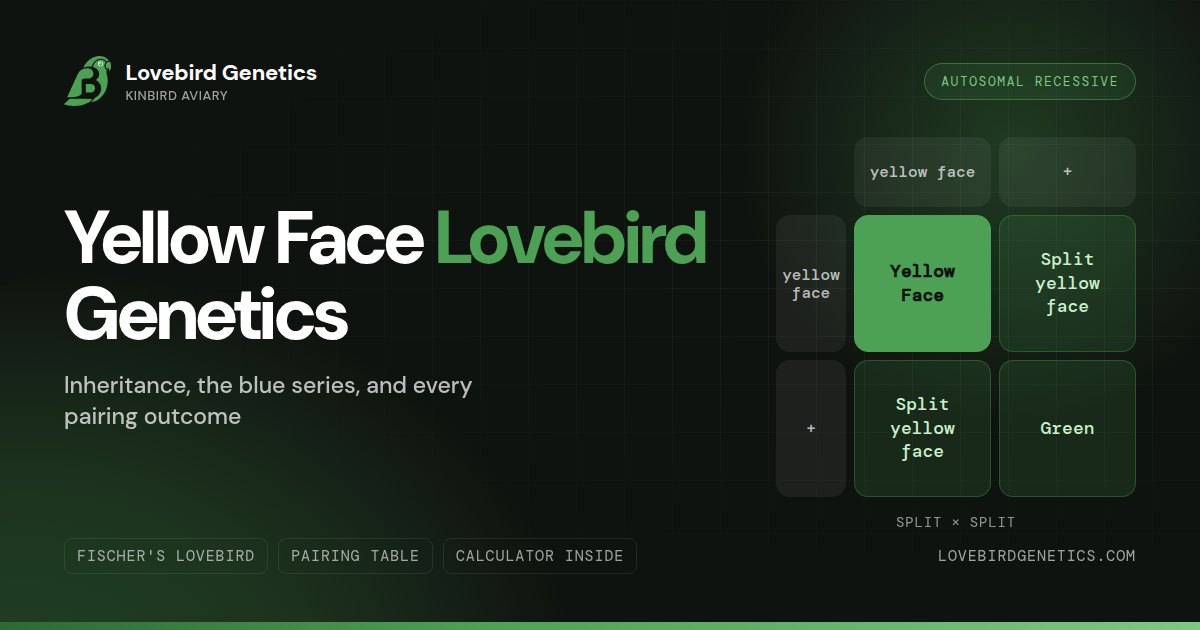
Inheritance: Autosomal recessive (AR), both males and females can be splits
Visual appearance: Bright yellow face mask instead of normal orange-red. Body colour depends on other mutations present.
Breeder demand: Among the highest for single-mutation Fischer's birds. YF Opaline and YF Aqua Homo are in strong demand in Pakistan, Bangladesh, Indonesia, and Europe.
The 2016 Compendium classified the early yellow-masked Fischer's birds as turquoise, a partial psittacine reduction (PPR) allele of the same blue (bl) locus as blue and aqua. Turquoise reduces psittacine by around 90 percent on the body, far more than aqua's roughly 50 percent, so it reads much closer to blue. It inherits autosomal recessive (Lovebird Compendium, Turquoise, pp. 304 to 317).
That classification has since moved. Ornitho-Genetics VZW's current Agapornis mutation list, updated 17 August 2025, records no turquoise in Agapornis fischeri at all. It lists aqua and orange face as original fischeri mutations, and gives orange face its own wild-type allele and gene symbol, of, inherited autosomal recessive on a locus of its own, separate from the bl locus that carries blue, aqua and parblue. This calculator models the of gene, which is why a green bird can carry a yellow mask (OGVZW, Agapornis mutation list, 17 August 2025).
What Is the Yellow Face Mutation?
The Yellow Face mutation in lovebirds replaces the orange-red facial mask with clean yellow by reducing the red psittacine pigment. It is autosomal recessive and shows most clearly on green birds. Its effect is progressively reduced across the blue series (Blue 1 YF, Parblue YF, Aqua YF), and on a full Blue bird there is little psittacofulvin left to reduce, so it is largely masked. In Fischer's lovebirds, Yellow Face is a trade name that has covered two different genes. Ornitho-Genetics VZW's current list records it as orange face (symbol of), an autosomal recessive mutation on its own locus, separate from the blue locus that carries Blue, Aqua and Parblue.
Yellow Face removes the red psittacine component and leaves the yellow, so it shows clearly on green-series birds, turning the orange-red mask to clean yellow. On a full Blue bird there is no psittacine left to reduce, so Yellow Face is largely masked there (Van den Abeele, Lovebird Compendium, 2016).
In wild-type Fischer's lovebirds, the face mask is orange-red, a result of psittacine pigments (specifically psittacofulvins) concentrated in the feathers of the head and upper chest. Yellow Face is a mutation that alters this pigment pathway, replacing the orange-red psittacofulvin expression with a clean, bright yellow.
The body plumage is unaffected by Yellow Face alone, a YF green bird has a normal green body with a yellow face. The mutation only visibly affects where psittacofulvin pigment is expressed, which in Fischer's lovebirds is primarily the face and bib area.
Yellow Face is distinct from Lutino (which removes eumelanin) and from Pale Fallow or Dun Fallow (which affect eumelanin differently). It is a pure pigment-pathway mutation on its own locus.
The pigment mechanism behind Yellow Face
To understand Yellow Face, it helps to understand what psittacofulvins are and how they create the orange-red face of a normal Fischer's lovebird. Psittacofulvins are parrot-exclusive pigments that range from yellow to red depending on their specific molecular form. In wild-type Fischer's lovebirds, the face feathers accumulate the red-orange form of psittacofulvins at high concentration, producing the distinctive bright mask. The Yellow Face mutation alters the specific form or concentration of psittacofulvins in the face feathers, the pigment is still being deposited, but it expresses as clean yellow rather than orange-red. The body psittacofulvins are largely unaffected, which is why YF green birds retain a normal green body with only the face changed.
An important contrast with budgerigars: in budgerigars (Melopsittacus undulatus), the "Yellow Face" mutation is a blue-series modifier that adds yellow to birds that would otherwise be solid blue. In Fischer's lovebirds, Yellow Face works the other way round, it reduces the red psittacine already present in the mask, so it reads most strongly where there is the most psittacine to reduce. On a green-series bird the change is obvious. On a full Blue bird there is little or no psittacofulvin left to reduce, so the trait is largely masked. The Yellow Face stock common in the hobby does leave a cream to pale yellow cast in the mask of partial blue-series birds such as Blue 1, Blue 2, Parblue and Aqua, but that tint is subtle next to the green-series expression.
How Yellow Face reads across green-series and blue-series birds
Yellow Face works by reducing the red psittacine pigment in the mask, so how strongly it reads depends on how much psittacofulvin the bird has to start with. On a green-series bird the effect is at its clearest: the orange-red mask becomes a clean, bright yellow. Moving through the blue series the effect is progressively reduced, because each step of the blue locus removes more psittacine from the plumage. Blue 1, Blue 2, Parblue and Aqua birds carrying Yellow Face usually show a cream to pale yellow cast in the mask rather than the vivid yellow of a green-series bird. On a full Blue bird there is little or no psittacofulvin left to reduce, so Yellow Face is largely masked and can be carried without being obvious to the eye. In practical terms, visual confirmation of Yellow Face is reliable on green-series birds and gets progressively harder as the base colour moves toward full blue.
Inheritance: Autosomal Recessive
Yellow Face is autosomal recessive, so a bird needs two copies to show it. Both the cock and the hen must carry the gene, as visual or split, before a single visual Yellow Face chick can appear. One carrier parent alone produces only more carriers, never a visual (Van den Abeele, Lovebird Compendium, 2016).
Yellow Face follows standard autosomal recessive (AR) inheritance. This means:
- Both males and females can carry YF as a hidden split, they look like normal orange-face birds but carry one copy of the YF gene
- A bird must have two copies of the YF gene to show the yellow face visually
- Two split YF birds paired together will produce 25% visual YF, 50% split YF, and 25% non-carrier normals
- There is no sex difference, the gene is not on the sex chromosome
A bird split for Yellow Face has a completely normal orange-red face. There is no partial or intermediate expression. Without DNA testing or confirmed pedigree, you cannot visually identify a YF split. Many breeders discover splits only when YF chicks appear unexpectedly.
Core Yellow Face Pairings
| 1.0 Yellow Face0.1 Yellow Face | ||
|---|---|---|
| Offspring | Chance | Note |
| Yellow Face visual | 100% | All chicks show yellow face, guaranteed |
| 1.0 Yellow Face0.1 Normal / YF split | ||
|---|---|---|
| Offspring | Chance | Note |
| Yellow Face visual | 50% | Shows yellow face |
| Split YF (normal appearance) | 50% | Carries one YF gene, orange-red face |
| 1.0 Normal / YF split0.1 Normal / YF split | ||
|---|---|---|
| Offspring | Chance | Note |
| Yellow Face visual | 25% | Shows yellow face |
| Split YF (normal appearance) | 50% | Carries one copy, undetectable visually |
| Normal non-carrier | 25% | No YF gene |
Calculate your exact YF pairing
Add Opaline, Aqua, or any other mutation alongside YFSought-after Yellow Face Combinations
Yellow Face's real breeder demand comes from combination birds. Because YF is autosomal recessive, it can combine freely with both sex-linked and autosomal recessive mutations. The most sought-after combinations are:
YF Opaline
The yellow face mask combined with Opaline's distinctive colour redistribution. One of the most visually striking Fischer's combinations. YF Opaline females are auto-sexed from an Opaline male × YF female pairing.
⭐ Very high demandYF Aqua
Yellow face with turquoise body. Both YF and Aqua are AR, so you need double-split birds to produce visual YF Aqua. Pairing two double-splits (YF/Aqua) gives ~6.25% chance of visual YF Aqua per chick.
⭐⭐ Strongly sought-afterYF Opaline Aqua
All three mutations combined, yellow face, opaline pattern, aqua body. A triple-combination bird requiring multi-generation planning. Among the rarest Fischer's lovebirds produced.
⭐⭐⭐ Collector's prizeYF Pale Fallow
Yellow face with the washed-out pastel tones of Pale Fallow. Both are AR. The combination produces a soft, almost golden-faced bird with reduced eumelanin throughout the plumage.
⭐⭐ High demandYellow Face Opaline: Auto-Sexing Advantage
One of the most practical breeding benefits of the YF Opaline combination comes from the sex-linked nature of Opaline. When you pair a YF Opaline male with a YF female, you get automatic sex-identification from the chicks:
- All Opaline chicks are female (because Opaline is sex-linked, females get it directly from their father)
- All non-Opaline chicks are male (split Opaline males that don't show the pattern)
This auto-sexing effect works specifically because Opaline is sex-linked. You can sex chicks at the nest without DNA testing. This makes the YF Opaline pairing especially efficient for production breeding.
For a full breakdown of Opaline sex-linked rules and all pairing outcomes, see the Opaline genetics guide.
Yellow Face across the blue series
Yellow Face is not a green-only mutation. Because it reduces the red psittacine in the mask, it stacks onto every colour in the blue series, where it reads as a cream to pale yellow cast rather than the vivid yellow seen on green, and those combinations are where the real breeder interest sits. A clean Blue 1 Yellow Face, Blue 2 Yellow Face or Parblue Yellow Face, or an Aqua carrying Yellow Face, is far more sought-after than the plain green form. The standout route: pairing a Blue 1 Yellow Face with a Blue 2 Yellow Face gives 100 percent Parblue (B1B2) Yellow Face, one of the cleanest ways to produce a Parblue YF bird.
There is a genetic limit worth stating plainly, because the two genes sit on separate loci. On a full blue bird (bl1/bl1 or bl2/bl2) there is no psittacine left for the of gene to reduce, so Yellow Face there is carried rather than visually shown. On aqua and parblue bases, which retain partial psittacine, it does show. Breeders still record and trade those carried birds as Blue 1 Yellow Face or Blue 2 Yellow Face on the strength of pedigree or a cross back to green, and the calculator tracks the gene either way. Try the whole series live:
Australian Yellow Face, Orange Face and Indonesian Yellow Face
You will see the same bird listed under several names: Australian Yellow Face, Orange Face, and Indonesian Yellow Face, and older listings sometimes confused it with Pale-headed. These are regional trade names for the yellow-mask phenotype, not separate mutations. As it spread through Indonesia, Australia and later the Philippines, its formal status was still open: Ornitho-Genetics VZW carried a question mark against "Australian Yellow Face / Orange Face" in their mutation table, because full recognition requires the colour to stay stable to adulthood, be reliably heritable, and have its mode of inheritance proven by test-matings. In the 2016 Compendium, Dirk Van den Abeele linked the Fischer's yellow-face look to the turquoise partial-psittacine-reduction (PPR) group on the blue locus.
The 2025 position is different. Ornitho-Genetics VZW's Agapornis mutation list, updated 17 August 2025, carries no turquoise in Agapornis fischeri at all. It lists orange face as an original fischeri mutation, and the OGVZW gene-symbol list gives it its own wild-type allele and symbol, of, inherited autosomal recessive on a separate locus from bl. MutaBase's live mutation table records the same thing. So the separation of loci is settled: the yellow mask can arrive by the bl route or by the of route, and they are not the same gene.
The naming is not settled, and Van den Abeele says so himself. An OGVZW FAQ dated 9 March 2025 puts it plainly: “We probably also have an ‘orange face’ mutation in Agapornis fischeri, but since the mask colour there is not red, but orange, we get now a yellow mask. The name ‘orange face’ or ‘factor orange’ will also cause confusion here, more time and research is needed to find a more appropriate name.” Read the hedge as written. The locus separation is certain; tying the hobby trade name “Yellow Face” to the of gene is a strong inference, not a closed case, and the name itself is still under review (OGVZW FAQ, 9 March 2025).
Green series vs blue series, the honest version. Yellow Face reduces the red psittacine in the mask, so it reads most clearly on a green-series bird: the orange-red mask turns clean yellow while the body stays green. On the blue series the picture is debated. A full blue bird has almost no psittacine left to reduce, so a pure red-reduction "yellow face" is largely carried rather than shown, and reappears when the line is crossed back to green. In practice, most Fischer's yellow-face stock behaves as a partial psittacine reduction gene that does tint the mask cream to pale yellow wherever some psittacine survives, across Blue 1, Blue 2, Parblue and Aqua, which is why Blue YF and Parblue YF birds exist and are widely kept. This calculator models Yellow Face as a trait that appears across the series, matching how breeders actually describe and record these birds.
Chick tell at the nest. Breeders report that Yellow Face chicks hatch with yellow down, unlike the orange-red down of a normal green chick or the white down of a blue-series chick. It is an early, if not fully reliable, clue before the mask feathers grow in.
How to Identify Yellow Face Birds
Yellow Face is easiest to confirm on a green-series bird, where the normal orange-red mask becomes clean yellow. On a full Blue bird the mask has no red to remove, so it stays close to white and the trait is hard to read by eye alone. Judge the mask under natural daylight (Van den Abeele, Lovebird Compendium, 2016).
Visual Yellow Face birds have an unmistakably bright yellow face, not orange, not orange-yellow, but clean yellow. Key identification points:
- Face mask: Pure yellow, replacing the orange-red of wild type. The transition from face to body plumage is sharp.
- Bib area: The upper chest blends from yellow into green (same gradient as a normal bird but yellow instead of orange-red)
- Eye colour: Normal dark brown eye, Yellow Face does not affect eye colour (unlike Pale Fallow which gives red eyes, or Lutino which gives red eyes)
- Body plumage: Unchanged by YF alone, a YF Green bird has a normal green body; a YF Opaline has Opaline colouring on the body
Under natural light vs artificial light
Yellow Face is one of the mutations that looks different depending on lighting. Under natural sunlight, the yellow face mask is unmistakably clean and bright. Under warm artificial lighting (incandescent or warm LED), the yellow can appear slightly orange-tinted, which sometimes causes confusion with normal birds. Always confirm Yellow Face identification under natural daylight or a full-spectrum light source. The key test: a normal orange-red face will shift toward red under warm light; a Yellow Face bird will look yellow-cream or lemon, not orange.
Yellow Face on Blue-base birds
On a Blue Fischer's lovebird, the normal face is white or near-white, because the Blue mutation has already removed almost all psittacofulvin. That leaves Yellow Face with very little red to reduce, so on a full Blue bird the trait is largely masked and the mask stays close to white. On the partial blue-series birds, Blue 1, Blue 2, Parblue and Aqua, the Yellow Face stock common in the hobby usually leaves a soft cream to pale yellow cast in the mask, which is a subtle but useful clue. Breeders working with blue lines who unexpectedly see cream-faced birds should consider YF as the explanation, a split for YF in the breeding stock is the most likely source.
Identifying and Confirming YF Splits
A bird split for Yellow Face looks 100% normal, the orange-red face is unchanged. There are only three ways to confirm a YF split:
- DNA test: Most reliable. A lab test will confirm if the bird carries one copy of the YF gene.
- Pedigree knowledge: If the bird came to you with confirmed parentage from the breeder (e.g., one YF visual parent), the non-YF-looking chicks are statistically split YF.
- Test pairing: Pair the suspected split with a confirmed YF visual bird. If any YF chicks appear, the bird is confirmed split.
History and Origin of Yellow Face in Fischer's Lovebirds
The Yellow Face mutation in Agapornis fischeri is documented in the Lovebird Compendium by Dirk Van den Abeele (2016) as an autosomal recessive mutation affecting psittacofulvin expression in the face feathers. It is one of a set of mutations that alter the face colouration rather than the body, a relatively uncommon category compared to the many body-colour mutations like Blue, Aqua, and Pale Fallow.
Established YF lines exist across South Asian, Middle Eastern, and European aviculture. In Bangladesh and Pakistan the Yellow Face mutation has become highly desirable as a combination bird, particularly YF Opaline, because the combination of the yellow face and the Opaline plumage redistribution produces a uniquely layered visual that is among the most sought-after in the hobby.
As with most autosomal recessive mutations in Fischer's lovebirds, the history of Yellow Face in captive collections is harder to trace precisely than in budgerigars, where mutation records extend back to the early 1900s. Van den Abeele's 2016 Compendium remains the most authoritative published source on YF genetics in Fischer's lovebirds specifically.
Yellow Face Combination Birds: The Breeding Priority List
Because Yellow Face is autosomal recessive, it stacks freely with sex-linked mutations (Opaline, Cinnamon) and other AR mutations (Aqua, Pale Fallow, Dilute) without chromosome linkage complications. Here is how the major combinations rank for breeding priority.
Yellow Face Opaline, top tier
One of the most sought-after YF combinations among breeders. Opaline is sex-linked, which allows you to auto-sex the Opaline offspring regardless of YF status. A YF Opaline male × YF female pairing produces Opaline daughters that are confirmed YF visual and non-Opaline sons that are split for both. The combined visual, yellow face with Opaline's redistributed plumage, is one of the most visually striking combinations in the Yellow Face group. YF Opaline females are specifically sought for breeding programmes.
Yellow Face Aqua, sought-after turquoise with yellow face
Yellow Face on an Aqua base replaces the pale face of a normal Aqua bird with a clean, bright yellow. On an Aqua B1 or B2 bird, the contrast between the yellow face and the turquoise body is visually distinct. On an Aqua Homo bird, the deeper turquoise makes the yellow face even more striking. Producing YF Aqua requires building splits for both YF and Aqua simultaneously, a two-to-three season project from starting materials. The resulting birds are among the most sought-after in the hobby, and Bangladeshi lines are regularly exported to keepers in the UAE.
Yellow Face Pale Fallow, the most delicate combination
Yellow Face on a Pale Fallow base produces a bird with soft, washed-out pastel plumage and a clear yellow face alongside the characteristic pink-red eyes of Pale Fallow. The combination is rarer than YF Opaline or YF Aqua because it requires stacking two AR mutations, and Pale Fallow itself is harder to source than Aqua in most markets. The YF Pale Fallow bird is a prestige breeding project, multiple seasons of careful split management lead to a bird that draws strong interest from specialist keepers.
YF Aqua Homo Opaline, the triple combination
The most ambitious Yellow Face combination, Aqua Homo Opaline Yellow Face, requires three separate mutations to be stacked: the sex-linked Opaline and two autosomal recessives (Aqua and YF). These birds are extremely rare, typically take four or more breeding seasons to produce from starting materials, and represent the top tier of Fischer's lovebird breeder demand.
Seasonal and Age-Related Expression of Yellow Face
One underappreciated aspect of Yellow Face in Fischer's lovebirds is how the mutation's visual expression changes with the bird's age and moulting cycle. Breeders who have raised YF birds consistently report that the yellow face mask is least vivid immediately after the first juvenile moult and most vivid in adult birds that have completed two or more seasonal moults.
At fledging (approximately 6-7 weeks from hatch), YF chicks show a face mask that may appear only slightly lighter or more golden than their siblings, the difference is visible but can be subtle, particularly in indoor lighting. By the 10-12 week mark, as the first post-juvenile moult completes, the clean bright yellow of a confirmed YF bird becomes unmistakeable. Adult YF birds in peak condition, well-nourished and in fresh plumage, show the richest yellow expression. Birds in moult or under nutritional stress can temporarily show a slightly duller or more orange-tinted face.
This age and moult dependency means that photographs taken at the wrong stage can be misleading. If you are assessing a YF bird remotely based on photographs, ask the owner to confirm the bird's age and whether the photos were taken in fresh or in-moult plumage. An adult bird in fresh plumage is the most reliable standard for visual confirmation.
Nutrition and Yellow Face Expression
Psittacofulvin pigmentation in parrots is affected by diet in ways that are not fully understood. While the genetic basis of Yellow Face is fixed, the mutation either expresses or it does not, the richness and cleanliness of the yellow pigment can vary somewhat with nutritional status. Birds fed a varied diet including fresh fruits, vegetables, and quality seed or pellet mixes tend to show stronger, more saturated yellow face colour than birds on a restricted or nutritionally deficient diet.
Carotenoid intake in particular may influence face colour expression. Carotenoids (from foods like red bell peppers, sweet potato, carrots, and leafy greens) support general feather and skin pigmentation in birds. YF Fischer's lovebirds on carotenoid-rich diets typically show a brighter, more vibrant yellow face than the same bird would show on a plain seed-only diet. This is a nutritional enhancement of an existing genetic trait, not a change in genotype, and it applies to normal orange-red Fischer's lovebirds as well (their face colour is also richer on better diets).
For breeders trying to produce the most visually striking YF birds for exhibition, dietary quality in the weeks before showing makes a visible difference to feather condition.
DNA Testing for Yellow Face: When to Use It
Because Yellow Face splits are visually indistinguishable from normal non-carriers, DNA testing is the only laboratory-grade confirmation method available without waiting for offspring. Avian DNA testing services (available through specialist avian veterinary laboratories and specialist bird genetics companies) can confirm whether a specific bird carries one or two copies of the YF allele, distinguishing between: visual YF (two copies), split YF (one copy), and non-carrier (zero copies).
DNA testing is most useful when: (1) you have acquired a bird described as a "split YF" and want confirmation before incorporating it into your breeding programme; (2) you have offspring from a pairing where YF should be present in some birds and want to identify which normal-looking birds are splits; (3) you are passing birds to knowledgeable breeders who expect DNA-confirmed split status.
A DNA mutation panel from a reputable avian lab typically tests multiple mutation sites in a single submission, which is more efficient than running separate single-mutation tests. For sought-after combination birds (for example, a suspected YF Aqua double-split), DNA confirmation removes the uncertainty that would otherwise take several breeding seasons of test pairings to resolve.
Using the Genetics Calculator for YF Combination Pairings
The Lovebird Genetics Calculator at lovebirdgenetics.com handles Yellow Face as a selectable autosomal recessive mutation that can be added to any base colour or mutation combination. When planning a YF Opaline pairing, you can select the Opaline status of the male parent (visual or split) and add Yellow Face to both parents to model the exact offspring distribution, including percentages for YF Opaline females, YF non-Opaline males, non-YF Opaline females, and the various split combinations that appear in the nest.
For triple-mutation pairings, YF Aqua Opaline, for example, the calculator handles all three mutation statuses simultaneously and shows the probability of each offspring type in a single output. This eliminates the manual probability multiplication across three independent loci, reducing calculation errors and allowing faster breeding programme planning. The calculator is particularly useful when you are evaluating the trade-off between different founding pair options, for instance, whether using a YF visual Aqua split male vs a YF split Aqua visual male produces a better offspring distribution for your breeding goals in the current season.
What Makes a Yellow Face Bird Worth Building a Line Around?
The strongest Yellow Face breeding stock combines three things: a clean, well-saturated yellow mask, confirmed pedigree, and a combination potential such as Opaline or Aqua split status. Demand follows clarity of expression and confirmed genetics far more than a bird's surface appearance alone.
When selecting a Yellow Face bird for a breeding programme rather than as a single pet, look first at the sharpness of the yellow. A confirmed visual YF in fresh adult plumage should show a clean lemon-to-golden mask with a crisp transition into the body plumage, not a muddy orange-tinged wash. A bird photographed in moult or under warm artificial light can mislead you, so assess the mask under natural daylight whenever possible. The cleaner and more evenly distributed the yellow, the more reliably it carries through to offspring.
Pedigree matters as much as appearance. A YF visual with documented parentage tells you which other mutations may be riding hidden in the line as splits. A YF bird that is also a confirmed Opaline carrier, or split for Aqua, is far more useful to a breeding plan than a plain YF visual of unknown background, because it shortens the path to the combination birds that draw the most interest. This is where the auto-sexing advantage of Yellow Face Opaline becomes a genuine planning tool: pairing a YF Opaline male to a YF female lets you read the sex of every Opaline chick straight from the nest, which removes DNA testing from your selection workflow and lets you set up next season's pairs months earlier.
For breeders working toward a stable Yellow Face line, the practical priority is to secure two unrelated visual YF birds of good mask quality first, then layer combination genetics in over subsequent generations using the calculator to map each step.
References
- Van den Abeele, D. (2016). Lovebird Compendium. Ornitho-Media. ISBN 978-90-822990-0-3. The definitive scientific reference for all Fischer's lovebird mutation genetics. Turquoise chapter, pp. 304 to 317.
- Ornitho-Genetics VZW. Mutations Agapornis, official species mutation list with gene symbols. Updated 17 August 2025. Lists orange face (symbol of) as an original Agapornis fischeri mutation, autosomal recessive, on its own locus; no turquoise is listed for A. fischeri.
- Ornitho-Genetics VZW. FAQ: the name orange face. 9 March 2025. States that an orange face mutation probably also exists in Agapornis fischeri, that the mask reads yellow there, and that a more appropriate name still needs research.
- Wikipedia contributors. Lovebird. Wikipedia, The Free Encyclopedia. Accessed 2026.
- BirdLife International. Agapornis fischeri, Fischer's Lovebird. BirdLife Species Factsheet. Accessed 2026.
Yellow Face pairing outcomes, cock × hen
Breeders usually describe a pairing as cock × hen. Below is every common Yellow Face pairing written that way, with the exact percentages this calculator produces.
What do you get from a Yellow Face cock x Yellow Face hen?
Every chick is a visual Yellow Face, cocks and hens alike. Because Yellow Face is autosomal recessive, sex plays no part in the outcome.
| Chicks | Outcome |
|---|---|
| All chicks | 100% visual Yellow Face |
What do you get from a Yellow Face cock x normal hen?
No visual chicks appear in this generation. Every chick is a normal-looking bird carrying one hidden copy, written as normal / Yellow Face.
| Chicks | Outcome |
|---|---|
| All chicks | 100% split (normal / Yellow Face) |
What do you get from a split Yellow Face cock x split Yellow Face hen?
One quarter of the chicks are visual Yellow Face. Half are splits and one quarter carry nothing, and the splits and pure normals look identical.
| Chicks | Outcome |
|---|---|
| All chicks | 25% visual Yellow Face, 50% split, 25% pure normal |
What do you get from a Yellow Face cock x split Yellow Face hen?
Half the chicks are visual Yellow Face and half are splits, with the same result whichever parent carries the visible mutation.
| Chicks | Outcome |
|---|---|
| All chicks | 50% visual Yellow Face, 50% split |
Run any of these in the lovebird genetics calculator to see the full offspring list for your own birds.