
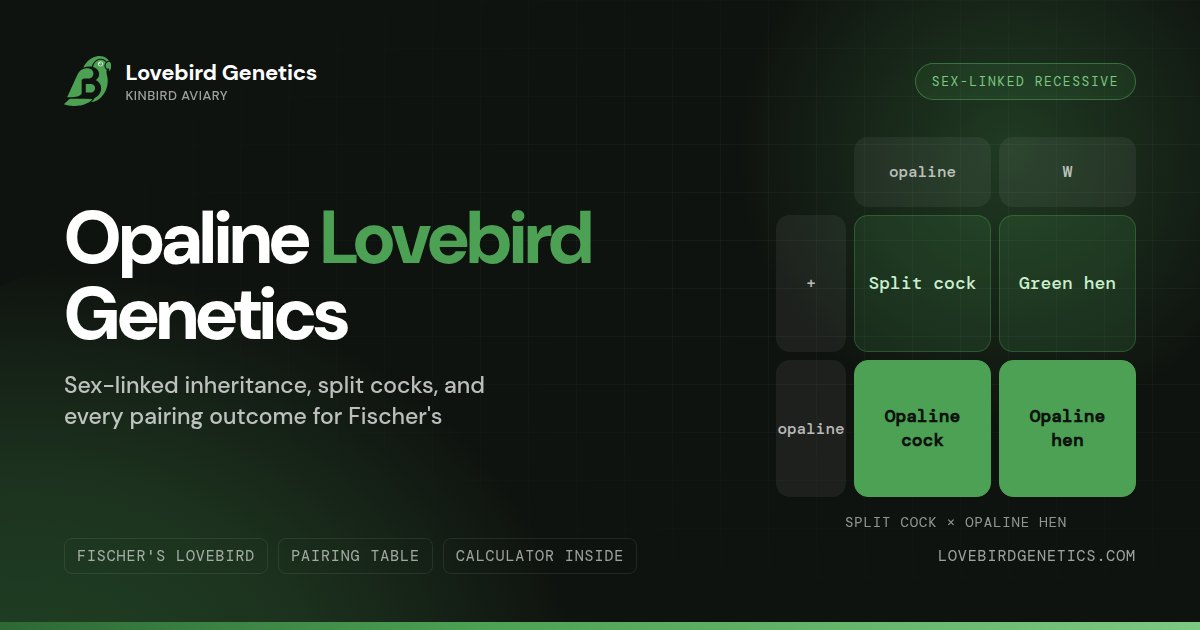
Opaline is sex-linked recessive. Males can be splits, females cannot. A Visual Opaline male paired with any normal female produces 100% Opaline daughters and 100% Split sons. To get Visual Opaline sons, both parents must carry or show Opaline.
Use the Lovebird Genetics Calculator to calculate any specific pairing instantly.
Opaline is a sex-linked recessive mutation that rearranges the plumage pigment rather than removing it. It was first confirmed in Agapornis roseicollis in January 1997 (Becky Anderson, Michigan, USA; Van den Abeele, Lovebird Compendium, p. 331), and in Agapornis fischeri it was reported from Hong Kong in 2010 and established in Indonesia. Split males can often be identified by their larger tail spots (Lovebird Compendium, pp. 330 to 343).
What is Opaline in lovebirds?
Opaline is one of the most popular and visually striking mutations in Agapornis fischeri (Fischer's lovebird). It causes a redistribution of psittacine pigment across the feather structure, producing a richer, more saturated appearance, often with a characteristic gradient effect on the wings and back where the body color bleeds into the flight feathers.
The result is a bird that appears more vivid and "reversed" in pattern compared to a normal. The face mask remains, but the psittacine (yellow/red) pigment is pushed into areas where it normally would not appear as strongly, including the wing coverts and sometimes the back.
Opaline is documented in detail in the Lovebird Compendium by Dirk Van den Abeele (2016), which is the primary scientific reference behind the genetics engine at lovebirdgenetics.com.
How Opaline works, in plain terms
Opaline does not add a new colour or remove one, it rearranges the pigment the bird already has. The red-orange mask spreads back over the crown, the body takes on a greyer-green cast, the rump turns green instead of the usual blue, and the tail feathers fill in with red. Because it only moves pigment around rather than reducing it, Opaline layers cleanly over almost any base, which is why Green Opaline, Aqua Opaline and Yellow Face Opaline all exist. It is sex-linked recessive, carried on the Z chromosome (Van den Abeele, Lovebird Compendium, pp. 330 to 343).
How sex-linked inheritance works
Opaline sits on the Z sex chromosome. In lovebirds, cocks are ZZ and hens are ZW. A hen carries only one Z, so she is either Visual Opaline or not Opaline at all, she can never be a hidden split. A cock needs two Opaline copies to show visually; with one copy he looks normal but is a confirmed split. This single rule explains every Opaline pairing outcome below. (Van den Abeele, Lovebird Compendium, 2016.)
What Z and W mean in lovebird genetics
Birds do not use X and Y. They use Z and W. A cock carries two Z chromosomes (ZZ). A hen carries one Z and one W (ZW). Opaline lives on the Z chromosome and the W carries no version of it at all, which is why a hen can never be split.
In the tables below, Z-op means a Z chromosome carrying Opaline, Z+ means a normal Z (the plus sign is the standard symbol for wild type), and W is the hen's second chromosome. 1.0 is breeder shorthand for one cock and 0.1 for one hen.
| Written as | Sex | What the bird is |
|---|---|---|
| Z-op / Z-op | Cock | Visual Opaline. Two copies, shows the colour. |
| Z-op / Z+ | Cock | Split Opaline. Looks normal, carries one copy, passes it to half his daughters. |
| Z-op / W | Hen | Visual Opaline. One copy is all a hen has, so she shows it. |
| Z+ / W | Hen | Normal. No Opaline anywhere, cannot carry it hidden. |
Opaline in lovebirds is sex-linked recessive (SL), the same inheritance pattern as Cinnamon and Pale, and as pallid, which OGVZW records as an original mutation in Fischer's. This is the most important thing to understand before planning any Opaline pairing.
Here is what sex-linked means in practice:
- Male lovebirds have two Z chromosomes (ZZ). They can carry Opaline on one Z chromosome without showing it, these are called Split Opaline males.
- Female lovebirds have one Z and one W chromosome (ZW). They cannot be splits. A female either carries Opaline on her single Z chromosome and shows it visually, or she does not carry it at all.
- There is no such thing as a Split Opaline female. This is one of the most common misconceptions among new breeders.
Female lovebirds cannot be splits for Opaline, Cinnamon, Pale, or pallid. Any bird described as a "split Opaline female" is either being mislabeled or the seller does not understand lovebird genetics. If a female shows no Opaline visually, she carries zero Opaline genes.
How to identify an Opaline visually
A Visual Opaline lovebird shows the following characteristics compared to a normal bird of the same base color:
- Wing coverts, the small feathers covering the wing base take on the body color rather than the typical green. This is the most reliable visual indicator.
- Richer saturation, the overall plumage appears more vivid and intense.
- Gradient effect, in many Opaline birds, the color transitions across the back and wing area, creating a distinctive ombre-like appearance.
- Mask colour redistributed, not removed, the red-orange mask spreads back over the crown and the head clears.
When combined with Aqua, Yellow Face, or Pale Fallow, the Opaline effect becomes even more dramatic, stacked Opaline combinations are among one of the most sought-after birds in the hobby.
The 5 core Opaline pairings
These five pairings cover the situations you will encounter most often as a breeder. All percentages have been verified through the Lovebird Genetics Calculator engine, which is built directly on the Lovebird Compendium's documented inheritance models.
| 1.0 Visual Opaline0.1 Normal | ||
|---|---|---|
| Offspring | Chance | Note |
| Visual Opaline (females) | 50% | All daughters are visual, guaranteed |
| Split Opaline (males) | 50% | All sons carry Opaline invisibly, confirmed splits |
This is the most predictable Opaline pairing. 100% of daughters will be Visual Opaline. 100% of sons will be confirmed Split Opaline. No normal birds are produced.
Calculate this pairing →Calculate Pairing 1 in the calculator
Visual Opaline Green Male × Normal Green Female, open with parents pre-selected| 1.0 Normal0.1 Visual Opaline | ||
|---|---|---|
| Offspring | Chance | Note |
| Split Opaline (males) | 50% | All sons are confirmed splits, carry but don't show |
| Normal (females) | 50% | All daughters are completely normal, no Opaline |
No Visual Opaline offspring in this generation, but all sons are confirmed Split Opaline, which you can use in the next breeding season to produce Visual Opaline daughters.
Calculate this pairing →| 1.0 Visual Opaline0.1 Visual Opaline | ||
|---|---|---|
| Offspring | Chance | Note |
| Visual Opaline (males) | 50% | Homozygous, carry two copies of the Opaline gene |
| Visual Opaline (females) | 50% | All daughters are visual Opaline |
100% Visual Opaline offspring from this pairing. The males produced here are homozygous, they carry two copies of the Opaline gene and will pass Opaline to 100% of their daughters.
Calculate this pairing →| 1.0 Split Opaline0.1 Normal | ||
|---|---|---|
| Offspring | Chance | Note |
| Split Opaline (males) | 25% | Look completely normal, carry one Opaline Z from father |
| Normal (males) | 25% | No Opaline gene at all |
| Visual Opaline (females) | 25% | Inherited father's Opaline Z, express it fully |
| Normal (females) | 25% | Inherited father's normal Z, carry nothing |
Half the daughters are visual Opaline (25 percent of the clutch) and the other half are normal. Half the sons are split and half are clear, and you cannot tell the splits apart from normal males by looking.
Calculate this pairing →| 1.0 Split Opaline0.1 Visual Opaline | ||
|---|---|---|
| Offspring | Chance | Note |
| Visual Opaline (males) | 25% | Homozygous males, two copies |
| Split Opaline (males) | 25% | Look normal, carry one Opaline Z from the mother |
| Visual Opaline (females) | 25% | Inherited the father's Opaline Z |
| Normal (females) | 25% | Inherited the father's normal Z, carry nothing |
This pairing produces Visual Opaline males (25%), which is rare and sought-after. The homozygous Visual Opaline males produced here will pass Opaline to 100% of their daughters.
Calculate this pairing →Calculate any Opaline pairing instantly
Select your exact parent colors and mutation statuses, results appear immediatelyOpaline combined with other mutations
Opaline's real value in the market comes from combination pairings, stacking Opaline with base colors and other mutations to produce rare, sought-after birds.
Opaline + Aqua (B1, B2, or Homo)
This is one of the most sought-after combinations in the South Asian, Middle Eastern, and European markets. Opaline enhances the Aqua coloring dramatically, the psittacine redistribution interacts with the Aqua base to produce a uniquely vibrant bird. Aqua B2 Opaline Visual females are among the most sought-after birds you can produce.
The genetics for these pairings can be complex, the Opaline (SL) and Aqua (base color allele) follow independent inheritance pathways. Use the calculator to map out your specific pairing.
Opaline + Yellow Face
Yellow Face is autosomal recessive, so it follows different inheritance rules from Opaline. When stacked together, Opaline Yellow Face birds show the Opaline feather redistribution pattern combined with the yellow facial wash of Yellow Face, a striking combination especially in the Aqua base.
Opaline + Pale Fallow or Ino
Combining Opaline with eumelanin-reducing mutations like Pale Fallow or Ino creates some of the rarest visual combinations. Opaline Pale Fallow shows strongly muted tones with the Opaline redistribution pattern. Opaline Ino (Lutino Opaline or Albino Opaline) is extremely rare and is in strong demand in every market.
Many breeders pair an Opaline with an Ino expecting to produce Opaline Lutino offspring in the first generation. This will not happen unless the Ino parent also carries or shows Opaline. Opaline is sex-linked, but Ino in Fischer's is autosomal recessive, so the two run on independent systems and must be worked out separately in every pairing calculation. Unlike Opaline, hens can be split for Ino. Use the calculator to avoid wasted pairings.
Why is Opaline so sought-after among Fischer's breeders?
Opaline draws steady interest for a practical reason: it is one of the few mutations that lets you sex chicks by colour at the nest, and it stacks beautifully with Aqua, Yellow Face, and Pale Fallow to create visually distinct birds that buyers recognise instantly.
The demand is not really about the single Opaline gene on its own. A plain Green Opaline is attractive but common. What breeders actively look for are the combination females: Aqua Homo Opaline, Yellow Face Opaline, and Pale Fallow Opaline. These require a male carrying or showing Opaline alongside the relevant autosomal recessive base, which means several seasons of disciplined pairing before the first visual combination female appears in a nest. That generational lead time is exactly what keeps these birds in short supply and in consistent demand.
Selecting good stock matters as much as the genetics. When I assess an Opaline for breeding, I look for clean psittacine redistribution across the wing coverts, a well-defined gradient rather than a muddy wash, and good feather quality on the mask. A bird with weak Opaline expression will pass weak expression to its daughters, so I keep only the strongest-patterned visuals as line founders and pass the rest on as pets. The sex-linked inheritance is also a genuine working advantage: a single proven Visual Opaline male can found an entire production line, since every one of his daughters is guaranteed Opaline.
Common breeder mistakes with Opaline
- Calling a female "split Opaline", impossible. If a female shows no Opaline, she carries none.
- Assuming all sons from an Opaline female are splits, only true if the father also carries Opaline. A normal male × Opaline female produces split sons, but a normal male × normal female where the grandmother was Opaline does NOT guarantee splits.
- Not tracking split males, Split Opaline males look completely normal. Without records, you lose track of which males carry Opaline.
- Expecting Opaline offspring in one generation from two "carriers", since females can't be splits, you can't have two split parents both passing Opaline the same way you can with AR mutations. The math is different, use the calculator.
Auto-Sexing Pairings: Sex Chicks at Hatch by Colour
The single most practically useful property of Opaline, and of all sex-linked recessive mutations, is that certain pairings allow you to determine the sex of chicks from their appearance alone, without DNA testing. This is called auto-sexing, and it saves breeders significant time and labour in large operations.
The classic auto-sex pairing: Visual Opaline male × Normal female
When you pair a visual Opaline male (ZOp ZOp) with a normal female (ZN W, where ZN indicates no Opaline allele on her single Z and W is her second sex chromosome), the result is fixed by the chromosome mathematics: every daughter inherits her father's ZOp chromosome and her mother's W chromosome, making every daughter ZOp W, a visual Opaline female. Every son inherits one Z from each parent, ZOp from father, Z from mother, making every son a split Opaline male that looks completely normal. This means you can sex every chick in this nest at the moment feather colour is visible: Opaline pattern = female, normal green pattern = male. No blood test, no feather DNA, no waiting for external features.
The reverse cross (not visually auto-sexing): Normal male × Visual Opaline female
The reverse pairing, normal male × visual Opaline female, does not auto-sex visually, because every chick in the nest looks normal. Every son is a split Opaline male (he inherits his mother's ZOp chromosome). Every daughter is a normal female (she inherits her father's Z without Opaline). The pairing is still useful, because you know with certainty that every son is a split Opaline for the next generation, but you cannot tell sons from daughters by colour and you will need DNA or a vent check.
The 50/50 auto-sex pairing: Split Opaline male × Normal female
When the male is a split Opaline (ZOp Z) rather than a visual, 50% of daughters will be visual Opaline and 50% will be normal-looking. Among sons, 50% will be split Opaline and 50% will be normal non-carrier. This pairing gives partial auto-sex information: every Opaline-appearing chick in the nest is definitively female. Every normal-appearing chick requires further investigation to distinguish between normal females and split/normal males.
History and Origin of Opaline in Fischer's Lovebirds
Opaline is one of the foundational mutations in Agapornis fischeri aviculture. While the exact year of first documentation in Fischer's lovebirds is less precisely recorded than in budgerigars (where Opaline was first noted in Australia in 1933), the Lovebird Compendium places the first confirmed Opaline in Agapornis roseicollis in January 1997, with the mutation reported in Agapornis fischeri from Hong Kong in 2010 and later established in Indonesia. The sex-linked inheritance mechanism was well understood in psittacines well before Fischer's lovebird Opaline was formally documented, which meant breeders could apply known genetic theory immediately once the mutation appeared.
The Lovebird Compendium by Dirk Van den Abeele (2016), the most comprehensive scientific reference for Fischer's lovebird colour genetics, documents Opaline as sex-linked recessive and describes the plumage changes in detail. Van den Abeele's Compendium is the primary published reference for Fischer's lovebird breeders and provides the genetic foundation for the pairing outcomes documented in this guide and in the Lovebird Genetics Calculator.
Opaline is now widespread across all major Fischer's lovebird breeding markets, Bangladesh, Pakistan, India, the UAE, the Philippines, Indonesia, and Europe. It is one of the first mutations that new breeders typically encounter, and its sex-linked inheritance makes it an excellent teaching mutation for understanding the ZZ/ZW chromosome system.
Opaline and the ZZ/ZW Chromosome System Explained
To fully understand why Opaline behaves the way it does, why females cannot be splits, why a Visual Opaline male gives 100% Opaline daughters, you need to understand the ZZ/ZW sex determination system that birds use.
Unlike mammals (where males are XY and females are XX), birds have a reversed system: males are ZZ (two copies of the Z sex chromosome) and females are ZW (one Z and one W chromosome). The W chromosome in birds carries very few functional genes, it is largely inert for trait inheritance purposes. The Z chromosome carries many functional genes, including sex-linked mutations like Opaline.
When Opaline is present on the Z chromosome: a male bird (ZZ) can carry Opaline on one Z chromosome without showing it, this is the split (ZOp Z). A female bird (ZW) can only have one Z chromosome. If that Z carries Opaline, the female shows it visually, she cannot "hide" it behind a second Z. If her Z does not carry Opaline, she shows none. There is no middle state for females.
This explains every Opaline pairing outcome: the Visual Opaline male (ZOp ZOp) always produces Opaline daughters because every daughter gets one of his Z chromosomes (which always carries ZOp). The normal male (Z Z) paired with an Opaline female (ZOp W) produces split sons (ZOp Z from mother's ZOp and father's Z) but normal daughters (Z W from father's Z and mother's W). Once this ZZ/ZW logic is clear, every Opaline pairing outcome follows directly from the chromosome mechanics.
Practical Record-Keeping for Opaline Lines
Because split Opaline males look identical to non-carrier males, record-keeping is the single most important tool in an Opaline breeding programme. Without records, splits get sold as normals, sought-after combinations get lost, and breeding seasons are wasted on non-productive pairings. Here are the minimum records every Opaline breeder should maintain.
Band every bird from birth
Close-banding (applying a permanent closed leg band at approximately 10-14 days of age, before the foot is too large) is the standard identification method for Fischer's lovebirds. Each band should have a unique identifier, year, nest number, and chick sequence (e.g., 26-A-3 = 2026, nest A, third chick). This identifier links the physical bird to your breeding records permanently and allows you to confirm parentage at any point.
Record genotype status per bird
For each bird in your programme, maintain a record of: (1) known mutations (visual or split); (2) parent IDs; (3) pairing history. For Opaline specifically, categorise each male as: confirmed Visual Opaline, confirmed Split Opaline (from a known pairing outcome), unconfirmed possible split, or confirmed non-carrier. Males in the "unconfirmed possible split" category should be test-paired with a Visual Opaline female before being used in a production pairing. One season of test pairing saves you from multiple seasons of wasted pairings with a non-carrier male you assumed was a split.
Photograph each bird at fledging
Visual Opaline birds are identifiable at fledging from the Opaline wing pattern. A dated photograph taken at the time of banding, stored alongside the band number, provides a permanent visual record that helps resolve disputes, confirms identification after cage changes, and supports pedigree documentation for sold birds. For buyers who are purchasing birds sight-unseen (e.g., via export), clear photographs with band numbers are essential for establishing trust and supporting sought-after demand.
Using the Calculator for Opaline Combination Pairings
The Lovebird Genetics Calculator handles Opaline as a sex-linked mutation with three selectable states per bird: visual (homozygous male or hemizygous female), split (heterozygous male only), and non-carrier. When you select a Visual Opaline male paired with a non-carrier female, the calculator correctly outputs 100% Visual Opaline daughters and 100% Split Opaline sons, the chromosome-level calculation is handled automatically.
For combination pairings involving Opaline alongside autosomal recessive mutations (Aqua, Pale Fallow, Yellow Face), the calculator models the independent inheritance of both the sex-linked Opaline pathway and the AR mutation pathways simultaneously. This is where manual probability calculation becomes error-prone, multiplying sex-linked probabilities by AR probabilities while tracking sex ratios across multiple mutation states. The calculator handles this automatically, which is why it is the recommended tool for any Opaline combination pairing with more than one additional mutation.
All five core Opaline pairings documented in this article are pre-linkable from the pairing boxes above. Clicking "Calculate this pairing" opens the calculator with the parent genotypes pre-selected, allowing you to add additional mutations (Aqua, YF, Pale Fallow) on top of the Opaline foundation pairing without re-entering the parent data from scratch.
References
- Van den Abeele, D. (2016). Lovebird Compendium. Ornitho-Media. ISBN 978-90-822990-0-3. The definitive scientific reference for all Fischer's lovebird mutation genetics.
- Wikipedia contributors. Lovebird. Wikipedia, The Free Encyclopedia. Accessed 2026.
- BirdLife International. Agapornis fischeri, Fischer's Lovebird. BirdLife Species Factsheet. Accessed 2026.
Opaline pairing outcomes, cock × hen
Breeders usually describe a pairing as cock × hen. Below is every common Opaline pairing written that way, with the exact percentages this calculator produces.
What do you get from an Opaline cock x normal hen?
Every son is a normal-looking split Opaline cock and every daughter is a visual Opaline hen. This is the classic auto-sexing pairing: you can sex the chicks by colour alone, with no DNA test.
| Chicks | Outcome |
|---|---|
| Sons | 100% normal / split Opaline |
| Daughters | 100% visual Opaline |
What do you get from a normal cock x Opaline hen?
Every son is a split Opaline cock and every daughter is a normal hen. No visual Opaline chicks are produced in this direction, which is why the sex of the Opaline parent decides everything.
| Chicks | Outcome |
|---|---|
| Sons | 100% normal / split Opaline |
| Daughters | 100% normal |
What do you get from a split Opaline cock x normal hen?
Half the daughters come out visual Opaline. Sons are split or normal in equal share and look identical, so only a test pairing or pedigree tells them apart.
| Chicks | Outcome |
|---|---|
| Sons | 50% split Opaline, 50% normal |
| Daughters | 50% visual Opaline, 50% normal |
What do you get from a split Opaline cock x Opaline hen?
This pairing produces visual Opaline in both sexes. Half the sons are visual Opaline and half are split, while half the daughters are visual Opaline.
| Chicks | Outcome |
|---|---|
| Sons | 50% visual Opaline, 50% split Opaline |
| Daughters | 50% visual Opaline, 50% normal |
What do you get from an Opaline cock x Opaline hen?
Every chick of both sexes is a visual Opaline. Nothing is hidden and no splits are produced, which makes this the fastest way to fix the mutation in a line.
| Chicks | Outcome |
|---|---|
| Sons | 100% visual Opaline |
| Daughters | 100% visual Opaline |
Run any of these in the lovebird genetics calculator to see the full offspring list for your own birds.