
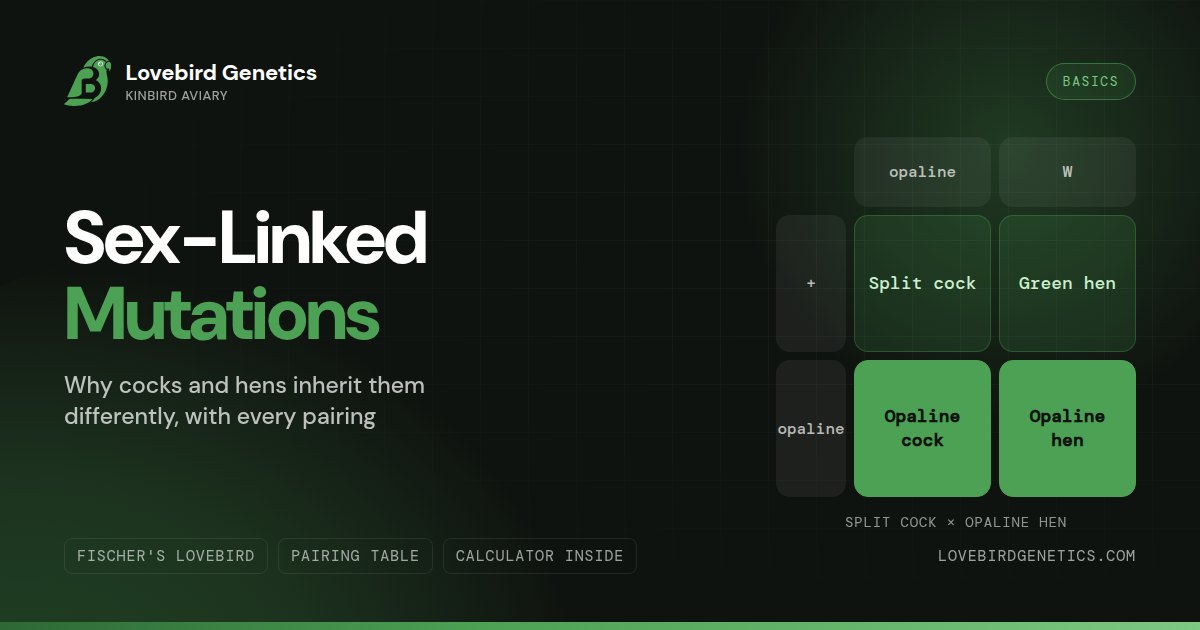
Sex-linked recessive mutations in Fischer's lovebirds (Opaline, Cinnamon, Pale) are carried on the Z sex chromosome. Males can be split carriers; females cannot. This creates auto-sexing pairings where you can determine chick sex by colour at hatch, without DNA testing.
In sex-linked recessive inheritance the gene sits on the Z chromosome. Males (ZZ) can be visual or split, but females (a single Z, then W) are only ever visual or normal, never split, so an Opaline, Cinnamon or Pale hen shows exactly what she carries. This is the rule that lets sex-linked pairings sex the chicks in the nest (Lovebird Compendium, genetics chapter, pp. 212 to 221).
The ZZ/ZW chromosome system in Fischer's lovebirds
Sex-linked mutations in lovebirds (Opaline, Cinnamon and Pale) sit on the Z chromosome. Males can be visual or hidden splits, but females are only ever visual or normal, never split, so a hen shows exactly what she carries. This lets many sex-linked pairings sex the chicks in the nest.
How birds differ from mammals in sex determination
In mammals, including humans, males are the heterogametic sex: males carry XY chromosomes, females carry XX. In birds, this is reversed. Female birds are the heterogametic sex: females are ZW (one Z chromosome and one W chromosome), while males are ZZ (two Z chromosomes). This single biological fact explains everything about sex-linked mutation inheritance in lovebirds.
The W chromosome in birds is largely gene-poor, it carries very few functional genes compared to the Z chromosome. The mutation loci for Opaline, Cinnamon, and Pale are located on the Z chromosome, not the W. This means sex-linked mutations in birds are always Z-linked, not X-linked as they would be in mammalian genetics.
What sex-linked recessive means mechanically
A sex-linked recessive mutation is one where the mutant allele is recessive, it is masked by the normal allele when both are present. In Fischer's lovebirds, the Opaline allele is recessive to the normal plumage allele at the same locus on the Z chromosome.
For the Opaline mutation to be expressed visually, a bird needs to have the Opaline allele at the relevant Z locus with no dominant normal allele to mask it. In a male (ZZ), this can happen in two ways: he can have Opaline on both Z chromosomes (homozygous visual, shows Opaline fully) or he can have Opaline on one Z and the normal allele on the other Z (heterozygous, the normal allele masks Opaline, so he looks normal but is a split carrier). In a female (ZW), she has only one Z. If that Z carries the Opaline allele, there is no second Z with a normal allele to mask it, she must show Opaline visually. If her Z carries the normal allele, she does not show Opaline and does not carry the gene.
Why males can be splits but females cannot
The split state requires two alleles at the same locus, one mutant, one normal. The normal allele dominates over the mutant recessive allele, hiding it. Males (ZZ) have two Z chromosomes, so they can have two alleles at every Z-linked locus, one on each Z. This makes it possible for a male to be Z(Opaline)/Z(normal): heterozygous, a split carrier who looks normal but passes Opaline to 50% of his daughters.
Females (ZW) have only one Z chromosome. They have only one allele at every Z-linked locus. There is no second allele to provide the masking effect. Whatever allele is on her single Z is expressed directly, either she shows Opaline (if her Z carries the Opaline allele) or she doesn't carry Opaline at all (if her Z carries the normal allele). The split state, carrying a hidden recessive allele on one chromosome while the other chromosome hides it, is structurally impossible for females in a ZZ/ZW system. This is not a convention or a rule, it is a direct consequence of the chromosome biology.
For Opaline, Cinnamon, and Pale: females are either Visual (they show it) or Normal (they don't carry it). Only males can be Split (hidden carriers). The term "split Opaline female" describes a genetically impossible bird.
The three sex-linked mutations in Fischer's lovebirds
In Agapornis fischeri, exactly three mutations are confirmed sex-linked recessive: Opaline, Cinnamon, and Pale. All three sit on the Z chromosome and obey the same ZZ/ZW mechanics. A pallid phenotype is reported in the species but has not been formally confirmed, and Greywing sits on the Z as well while behaving as an incomplete dominant rather than a recessive. The Ino mutation is autosomal recessive in Fischer's, so it does not belong to this group (Van den Abeele, Lovebird Compendium, 2016).
In Agapornis fischeri, exactly three mutations are sex-linked recessive. All three follow identical ZZ/ZW inheritance mechanics, the differences between them are visual (what the mutation looks like) and molecular (which gene is affected), not genetic-inheritance (how the gene passes between generations).
Opaline
Opaline is the most highly sought-after sex-linked mutation in Fischer's lovebirds. The Opaline allele modifies the spatial distribution of psittacofulvin pigment (the red and yellow psittacine pigments) across the feather structure, producing a distinctive redistribution effect. In a normal Fischer's lovebird, the red face mask is sharply defined and the body feathers are predominantly green. In an Opaline Fischer's, the colour gradient extends into the wing coverts and the body feathers, creating a richer, more saturated and visually complex appearance.
The Opaline combinations breeders ask about most are Aqua Homo Opaline hen and Yellow Face Opaline hen. The redistribution effect of Opaline enhances the already-distinctive turquoise colour of Aqua birds, producing a deeply saturated visual that is immediately recognisable even to non-breeders. See: Opaline Lovebird Genetics: The Complete Guide →
Cinnamon
Cinnamon is a sex-linked recessive mutation affecting the TRP1 (Tyrosinase-Related Protein 1) gene, which is involved in the enzymatic processing of eumelanin, the dark brown-black pigment responsible for feather structure definition and wing markings in Fischer's lovebirds. In Cinnamon birds, TRP1 function is reduced, resulting in incomplete eumelanin deposition. Dark feathers soften from near-black to a warm cinnamon-brown, giving the bird a distinctly warmer, softer tone throughout the plumage.
The inheritance rule is identical to Opaline: Cinnamon hens are either visual or non-carrier; only Cinnamon cocks can be splits. Cinnamon combined with Aqua produces a particularly striking result, the Cinnamon-brown replaces the dark green tones while Aqua reduces the yellow psittacine pigment at the blue locus, so the remaining eumelanin reads cooler, producing a warm turquoise bird with softened markings. Aqua acts on psittacofulvin, not on eumelanin. See: Cinnamon Lovebird Genetics →
Pale
Pale is the third confirmed sex-linked recessive mutation in Fischer's lovebirds and is the least common in popular breeding lines. Pale reduces melanin expression more broadly than Cinnamon, producing a washed-out, pastel appearance while retaining the overall hue of the base colour. A Pale green Fischer's lovebird looks lighter and more washed-out than a normal bird, without the distinctly warm-brown tone of Cinnamon.
Pale Opaline combinations are among the softest-looking Fischer's mutations: the combined effect of Opaline redistribution and Pale's overall lightening creates birds with a very delicate, pale gradient appearance. Because Pale is rarer in established lines, confirmed split Pale cocks are harder to find.
A separate pallid phenotype is also reported in Fischer's lovebirds and appears as a selectable trait in the calculator, but it has not been formally confirmed in this species the way Opaline, Cinnamon and Pale have. If you keep a bird labelled pallid, record exactly what its parents produced rather than assuming the label is settled.
In Agapornis roseicollis (Peach-faced lovebird), the Ino gene (Lutino/Albino) lies on the Z chromosome, so a Peach-faced hen can never be a hidden carrier of it. In Agapornis fischeri, the same mutation is autosomal recessive: it sits on an ordinary chromosome, and both cocks and hens can be splits for it. This difference catches breeders who work with both species. The calculator is built for Fischer's, where it behaves as autosomal recessive.
The 4 core sex-linked pairings
A hen carries one Z, so she is either visual or non-carrier and can never be a hidden split. Because daughters take their single Z from the father, the sex-linked gene only ever advances through a cock who carries or shows it. To produce a new generation of visual hens you always need a Visual or Split male, never a hen alone (Van den Abeele, Lovebird Compendium, 2016).
Using Opaline as the example (same rules apply to Cinnamon and Pale):
| 1.0 Visual Opaline0.1 Normal | ||
|---|---|---|
| Offspring | Chance | Note |
| ♂ Split Opaline Males | 50% | Every son, looks normal, confirmed carrier |
| ♀ Visual Opaline Females | 50% | Every daughter shows Opaline fully |
Fully auto-sexing: every chick that shows Opaline is a hen, and every chick that looks normal is a cock carrying the gene.
Try this pairing →| 1.0 Split Opaline0.1 Normal | ||
|---|---|---|
| Offspring | Chance | Note |
| ♂ Split Opaline Males | 25% | |
| ♀ Visual Opaline Females | 25% | Auto-sexed: every Visual chick is female |
| ♂ Normal Males | 25% | |
| ♀ Normal Females | 25% | |
Auto-sexing rule: in this pairing, every Visual Opaline chick is guaranteed female. No DNA testing needed to sex visuals.
Try this pairing →| 1.0 Visual Opaline0.1 Visual Opaline | ||
|---|---|---|
| Offspring | Chance | Note |
| ♂ Visual Opaline Males | 50% | Homozygous, guaranteed to pass Opaline to all daughters |
| ♀ Visual Opaline Females | 50% | Every daughter shows Opaline |
Every chick is Visual Opaline. This is the pairing that produces homozygous Opaline cocks, but colour no longer sexes the clutch.
Try this pairing →| 1.0 Normal0.1 Visual Opaline | ||
|---|---|---|
| Offspring | Chance | Note |
| ♂ Split Opaline Males | 50% | Every son, confirmed carrier, inherits the mother's Opaline Z |
| ♀ Normal Females | 50% | Every daughter takes her only Z from the normal father |
Every son is Split Opaline and confirmed by parentage (he inherited his mother's Z), so no test pairing is needed. No chick shows Opaline, so this pairing does not auto-sex.
Try this pairing →How to produce an Opaline female: step-by-step
Opaline hens are among the birds breeders most want to produce, especially in combination with Aqua, Pale Fallow, or Yellow Face. There are three routes to producing them, from fastest to most efficient over multiple seasons:
Route 1, Use a Visual Opaline male (fastest, most predictable)
A Visual Opaline male paired with any female will produce Opaline daughters. This is Pairing 1 from the section above.
- Pair a Visual Opaline male with a Normal female (or any AR-mutation carrier female for combination birds)
- Every chick that shows Opaline is guaranteed to be female, no DNA test required
- Every daughter will be Visual Opaline
- Every son will be Split Opaline and will look completely normal
This is the fastest and most reliable route. If you already have a strong Visual Opaline cock in a combination you want (for example an Aqua Homo Opaline cock), his Opaline daughters will carry that combination forward on the hen side.
Route 2, Use a Split Opaline male (auto-sexed production)
If you have a confirmed Split Opaline male but no Visual yet, this is Pairing 2:
- Pair the Split Opaline male with a Normal female
- 25% of all offspring will be Visual Opaline females, and every Visual Opaline chick from this pairing is guaranteed female
- 25% will be Split Opaline males (normal-looking confirmed carriers)
- 50% will be Normal (half male, half female)
From a split male, you get fewer Opaline females per nest than from a Visual male, but the auto-sexing rule still holds: every visual chick is female.
Route 3, Build the line from an Opaline female
If you start with only an Opaline female and a Normal male (Pairing 4), all sons will be Split Opaline. Retain those split sons. In the following season, use them in Pairing 2 to produce Opaline females from a split male. Over two seasons, this builds a self-sustaining Opaline production line.
An Opaline female cannot pass Opaline to her daughters directly. She passes her Opaline Z chromosome only to her sons (who become splits). Her daughters inherit her W chromosome, which carries no gene at all. To produce the next generation of Opaline females, you always need a male who carries the gene, either as a Visual or a Split. This is the fundamental rule of sex-linked breeding in lovebirds.
Complete sex-linked pairing reference
All four core pairings with male and female offspring separated. The same table applies to Cinnamon and Pale, substitute the mutation name. Use the calculator for exact percentages when combining sex-linked mutations with autosomal recessive traits.
| Pairing | ♂ Males | ♀ Females |
|---|---|---|
| Visual ♂ × Normal ♀ | 100% Split | 100% Visual |
| Split ♂ × Normal ♀ | 50% Split, 50% Normal | 50% Visual, 50% Normal |
| Visual ♂ × Visual ♀ | 100% Visual | 100% Visual |
| Normal ♂ × Visual ♀ | 100% Split | 100% Normal |
Note: percentages above are within each sex. Overall per-chick chance = divide by 2 (since roughly 50% of the nest will be male, 50% female).
The auto-sexing advantage
Pair a sex-linked cock that shows the mutation over a normal hen, and every chick that shows the colour is guaranteed female while every chick without it is a male. You read the sex of the whole clutch straight from plumage colour at hatch, with no DNA test (Van den Abeele, Lovebird Compendium, 2016).
One of the most practical benefits of sex-linked mutations: in certain pairings, the presence of the visual mutation automatically identifies the sex of the chick without DNA testing.
In pairings 1 and 2 above, every Visual Opaline offspring is female, guaranteed. This is because a hen needs only one copy of the Opaline gene (on her single Z chromosome) to show it, while a cock needs two. When the mother is a normal hen she has no Opaline Z to give her sons, so no son can be visual, and every chick that shows Opaline must be a daughter.
Breeders use this deliberately: a split Opaline male paired with a normal female will auto-sex every Opaline chick as female at hatch, no waiting, no DNA test needed.
Model sex-linked pairings instantly
The calculator shows separate male and female outcome columns for all sex-linked mutationsReading the calculator for sex-linked mutations
When you run a pairing involving Opaline, Cinnamon, or Pale in the genetics calculator, the results show two separate columns: Male offspring and Female offspring. Understanding how to read these columns correctly is important because sex-linked mutations behave differently in each sex.
- In the female column: Opaline appears only as Visual or Normal, never as "Split." If you see Opaline in the female column, it means visual expression, not a hidden carrier.
- In the male column: Opaline can appear as Visual, Split, or Normal. Split males look identical to Normal males, you cannot tell them apart visually.
- When combining Z-linked mutations with autosomal recessive traits (Aqua, Ino, Pale Fallow), the calculator handles both simultaneously. A result like "Visual Opaline / Aqua" in the female column means: that hen shows Opaline and also carries one hidden Aqua allele.
The most important column for breeders targeting Opaline females is always the female column. That percentage tells you exactly what fraction of your female offspring will be Visual Opaline, regardless of what the nest looks like overall.
Common mistakes in sex-linked breeding
These errors come up repeatedly, especially for breeders new to sex-linked genetics:
Passing split males on as normals
A Split Opaline male looks completely normal. If you don't record which males came from which pairings, a confirmed split male can leave your aviary labelled as plain normal stock. Whoever receives him is then baffled when his "normal" male produces Opaline daughters. Always record the parentage of every bird and label split males clearly in your breeding records.
Expecting daughters to be splits
New breeders often ask: "My Opaline female doesn't look visual, she must be split, right?" No. In Fischer's lovebirds, a hen that carries Opaline will show it. If she doesn't show Opaline, she doesn't carry the gene. There is no such thing as a hen split for Opaline, Cinnamon, or Pale.
Confusing Fischer's sex-linkage with Peach-faced
In Agapornis roseicollis, the Ino gene (Lutino/Albino) lies on the Z chromosome, so hens cannot be split for it. In Agapornis fischeri, the same mutation is autosomal recessive, and both cocks and hens can be splits. This difference catches breeders who move between species.
Sex-linked mutations combined with autosomal recessive traits
The Z-linked mutations (Opaline, Cinnamon, Pale) and the autosomal recessive mutations (Aqua Homo, Pale Fallow, Dun Fallow, Ino, Dilute) follow independent inheritance pathways, both gene systems segregate separately, following Mendel's law of independent assortment. Aqua is worth reading carefully here: only Aqua Homo behaves as a plain autosomal recessive, while Aqua B1 and Aqua B2 are co-dominant compounds of two different blue-locus alleles. This means a pairing involving Opaline (sex-linked) and Aqua at the blue locus simultaneously produces offspring where the two gene systems sort independently, and the calculator handles all combinations at once.
For example: a split Opaline cock who also carries one Aqua allele, paired with an Aqua Homo hen. The Opaline component follows sex-linked rules (25% visual Opaline hens, 25% non-carrier hens, 25% split Opaline cocks, 25% non-carrier cocks). The Aqua component follows autosomal recessive rules (50% visual Aqua Homo, 50% carrying one hidden Aqua allele, in both sexes alike). Combined, the calculator shows all offspring categories at once, including the category most breeders are aiming at: Aqua Homo Opaline hens, which express both mutations together.
Combined mutations like Opaline Aqua hens are the sex-linked birds breeders aim for most. A Visual Aqua Homo Opaline hen combines the deepest turquoise base with Opaline's plumage redistribution, making it one of the most distinctive Fischer's lovebirds. Use the Lovebird Genetics Calculator to model any combined Opaline × AR pairing. See the Opaline guide for detailed combination examples: Opaline Lovebird Genetics →
Why are sex-linked mutations so sought-after to breed?
Sex-linked mutations carry a working advantage no other mutation class offers: auto-sexing. In the right pairing, every chick that shows the mutation is guaranteed female, which lets a breeder sex an entire clutch by colour at the nest, with no DNA test and no waiting for adult features.
That auto-sexing property is the practical reason Opaline, Cinnamon, and Pale stay so popular. A Visual Opaline cock over normal hens produces only Opaline daughters and split sons, so the breeder knows the sex of every chick the moment colour shows. For anyone running many pairs, that certainty matters far more than the colour alone, and it is why proven sex-linked cocks are the birds breeders hold on to as line founders. The catch is that hens cannot be splits, so the gene only ever moves forward through a cock who carries or shows it. Losing track of which cocks are split, through poor records, can set a programme back a full season, which keeps confirmed-carrier cocks genuinely scarce.
What breeders look for in sex-linked stock is consistency of expression and confirmed genotype. I keep only the strongest-patterned Visual hens as the benchmark for a line, and I favour a cock whose split status is confirmed by parentage rather than guessed at, because a guessed split wastes a breeding season if he turns out to be a non-carrier. The combination hens, especially Aqua Homo Opaline, are the birds breeders ask about most, and producing them takes several seasons of stacking the sex-linked gene onto an autosomal recessive base. The Lovebird Compendium (Van den Abeele, 2016) documents Opaline, Cinnamon and Pale as sex-linked recessive in Agapornis fischeri, and that generational lead time is exactly why well-bred sex-linked birds stay uncommon.
History and origin of sex-linked mutations in Fischer's lovebirds
The Opaline mutation in Fischer's lovebirds was first documented in European aviaries during the 1980s, appearing spontaneously in established green breeding lines. The distinctive redistribution of colour was recognised immediately as something breeders wanted to fix in their lines. Early Opaline birds from Belgium and the Netherlands reached South African and Asian breeders during the late 1980s and 1990s.
The sex-linked inheritance of Opaline in Fischer's lovebirds was confirmed relatively quickly by European breeders who noticed that Opaline offspring were predominantly female, the auto-sexing pattern made the Z-linked mechanism apparent without formal genetic analysis. The distinction from Peach-faced lovebird genetics, where the Ino gene also lies on the Z chromosome, versus Fischer's lovebird genetics, where Opaline, Cinnamon and Pale are the Z-linked recessives while the Ino gene is autosomal, was formally documented in Dirk Van den Abeele's Lovebird Compendium (2016), which remains the standard reference for Fischer's mutation genetics.
Cinnamon and Pale in Fischer's lovebirds were documented and confirmed as sex-linked later than Opaline. Cinnamon spread through the same European-to-Asian channels as Opaline, and by the mid-2000s was established in Indonesian and Philippine breeding lines that later reached breeders across South Asia. Pale arrived in South Asian aviaries later still and remains rare in established lines as of 2026, and the reported pallid form is rarer again.
The intersection of sex-linked mutations with the scarce autosomal recessive mutations, particularly Aqua, which developed mainly in Indonesian lines from the 1990s onward, created the combination birds breeders chase today. An Aqua Homo Opaline hen, combining an Indonesian autosomal recessive mutation with a European sex-linked mutation, brings two distinct geographic breeding traditions together in a single bird.
For the scientific species profile and conservation context, see: Fischer's Lovebird, Wikipedia and BirdLife International: Agapornis fischeri species factsheet.
References
- Van den Abeele, D. (2016). Lovebird Compendium. Ornitho-Media. ISBN 978-90-822990-0-3.
- Wikipedia contributors. Lovebird. Wikipedia, The Free Encyclopedia. Accessed 2026.
- BirdLife International. Agapornis fischeri, Fischer's Lovebird. BirdLife Species Factsheet. Accessed 2026.
Frequently asked questions
Which lovebird mutations are sex-linked?
In Agapornis fischeri, three mutations are confirmed sex-linked recessive: Opaline, Cinnamon, and Pale. All three are carried on the Z chromosome. A pallid phenotype is also reported in the species but has not been formally confirmed, and Greywing sits on the Z as an incomplete dominant rather than a recessive. The Ino mutation is autosomal recessive in Fischer's, so both cocks and hens can be splits for it, unlike in Peach-faced lovebirds where that gene lies on the Z.
Why can't female lovebirds be split for Opaline?
Female birds are ZW, they have only one Z chromosome. For a recessive gene to be hidden, a bird needs two Z chromosomes so the normal gene can mask the mutated one. Since females have only one Z, whatever gene is on it is expressed. Only males (ZZ) can carry sex-linked mutations as hidden splits.
What does "split for Opaline" mean in a male lovebird?
A male split for Opaline looks completely normal visually. He carries the Opaline gene on one Z chromosome and the normal gene on the other. When paired with a normal female, 50% of his daughters will be Visual Opaline and 50% of his sons will be split for Opaline.
What pairing gives 100% Opaline daughters?
A Visual Opaline male (homozygous) paired with any normal female will produce 100% Opaline daughters. All daughters inherit the father's Opaline Z chromosome. Sons will all be split for Opaline.
Is Cinnamon in Fischer's lovebirds the same as in Peach-faced?
Both affect eumelanin via the TRP1 gene and both are sex-linked recessive, the inheritance pattern is identical. However, the visual expression may differ slightly between species. The calculator is built specifically for Agapornis fischeri.
Can you tell if a male lovebird is split for Opaline just by looking at him?
No. A Split Opaline male looks completely normal, his plumage shows no sign of Opaline. The only ways to confirm split status are: (1) parentage records, if his mother is Opaline, all her sons are confirmed splits; (2) test pairing, breed him with a Normal female and look for Opaline daughters; or (3) DNA testing. Without one of these, a split male is visually indistinguishable from a normal male.
What is the most sought-after Opaline combination in Fischer's lovebirds?
Aqua Homo Opaline hen is the combination breeders ask about most often across Bangladesh, Pakistan, and Southeast Asia. The Opaline redistribution enhances the Aqua turquoise colour significantly, producing a deeply saturated gradient bird that looks visually distinct from either mutation alone. Yellow Face Opaline and Pale Fallow Opaline hens are also widely admired combinations.
How do Opaline pairings differ when combined with Aqua?
When Opaline (sex-linked) is combined with Aqua (a blue-locus mutation, where only Aqua Homo is a plain autosomal recessive and Aqua B1 and Aqua B2 are co-dominant compounds), the two gene systems segregate independently. The calculator models both simultaneously. For example: a Visual Opaline cock that also carries Aqua as a split, paired with an Aqua Homo hen, produces a full breakdown showing which offspring are Aqua Homo Opaline hens, which are Green / Aqua Opaline hens, and which cocks carry the various combinations, all in one result table.
What is auto-sexing in lovebird breeding?
Auto-sexing means the visual appearance of a chick tells you its sex without DNA testing. In a sex-linked pairing where the hen is normal and the cock shows or carries the mutation (Visual cock × Normal hen, or Split cock × Normal hen), every chick that shows Opaline is guaranteed to be female. This works because a hen needs only one copy of the gene to show it while a cock needs two, and a normal mother has none to give her sons. Breeders use this to avoid DNA testing on entire clutches.
Can a female lovebird be split for a sex-linked mutation?
No. In Agapornis fischeri, a hen is ZW, meaning she carries only one Z chromosome. Sex-linked mutations, which in Agapornis fischeri are Opaline, Cinnamon and Pale, sit on the Z chromosome. Because a hen has only one Z, there is no second Z to mask a recessive allele. Whatever sits on her single Z is expressed directly, so a hen is either visual for the mutation or she does not carry it at all. The split state requires two alleles at one locus, which is structurally impossible for a hen. The phrase split Opaline hen describes a bird that cannot exist.
How does a hen's single Z chromosome determine her sons?
A cock is ZZ and a hen is ZW. When they breed, every son receives one Z from his mother and one Z from his father. This means the hen passes her single Z directly to all of her sons. If she is a visual Opaline hen, every son inherits her Opaline Z and becomes at least split for Opaline. Her daughters, by contrast, receive her W chromosome, which carries no sex-linked colour gene, so a hen cannot pass a sex-linked mutation to her daughters. This is the mother-to-son transmission rule that defines sex-linked breeding.
Why does a visual Opaline hen produce no Opaline daughters with a normal cock?
A daughter receives her Z chromosome from her father and her W from her mother. If the father is a normal cock with no Opaline allele on either Z, none of the daughters can inherit an Opaline Z. The mother's Opaline gene sits on her Z, which she gives only to her sons. So a visual Opaline hen paired with a normal cock produces split Opaline sons and normal daughters. To get Opaline daughters, the father must carry or show the mutation. This is the most common point of confusion for new hen breeders.
Can hens carry autosomal recessive mutations as splits?
Yes. Autosomal recessive mutations such as Aqua Homo, Pale Fallow, Dun Fallow, Dilute and Ino in Fischer's lovebirds are carried on ordinary chromosomes, not on the Z. Both cocks and hens have two copies of every autosomal chromosome, so a hen can be split for an autosomal recessive mutation in exactly the same way a cock can. The hen looks normal but carries one hidden recessive allele. Only Aqua Homo is a plain autosomal recessive; Aqua B1 and Aqua B2 are co-dominant compounds at the blue locus, not splits. This is why the no-splits rule applies only to sex-linked mutations. A hen can be a Green / Aqua carrier, but she cannot be split Opaline.
How do I sex chicks at hatch using the hen's genotype?
Auto-sexing works when the hen is normal and the cock carries or shows a sex-linked mutation. In a pairing such as a visual or split cock over a normal hen, any chick that shows the mutation must be female, because a hen needs only one copy to show it while a cock needs two, and a normal mother has none to give her sons. Reading the cock and hen genotypes in the calculator tells you in advance whether a clutch will auto-sex by colour. The hen's role is to receive the father's Z in her daughters, which is what makes the visual trait act as a sex marker at hatch.
What pedigree red flags should I watch for in a hen?
The biggest red flag is any record that lists a hen as split for a sex-linked mutation such as split Opaline, split Cinnamon or split Pale. No such hen exists, so the record is wrong and the rest of the pedigree should be treated with caution. A second red flag is a visual sex-linked hen whose sire showed no trace of the mutation and was not a confirmed split, because a visual hen must inherit her single Z from her father. A third is a clutch of supposed sex-linked daughters from a normal cock, which is genetically impossible. Each of these points to a mislabelled or mis-sexed bird.