
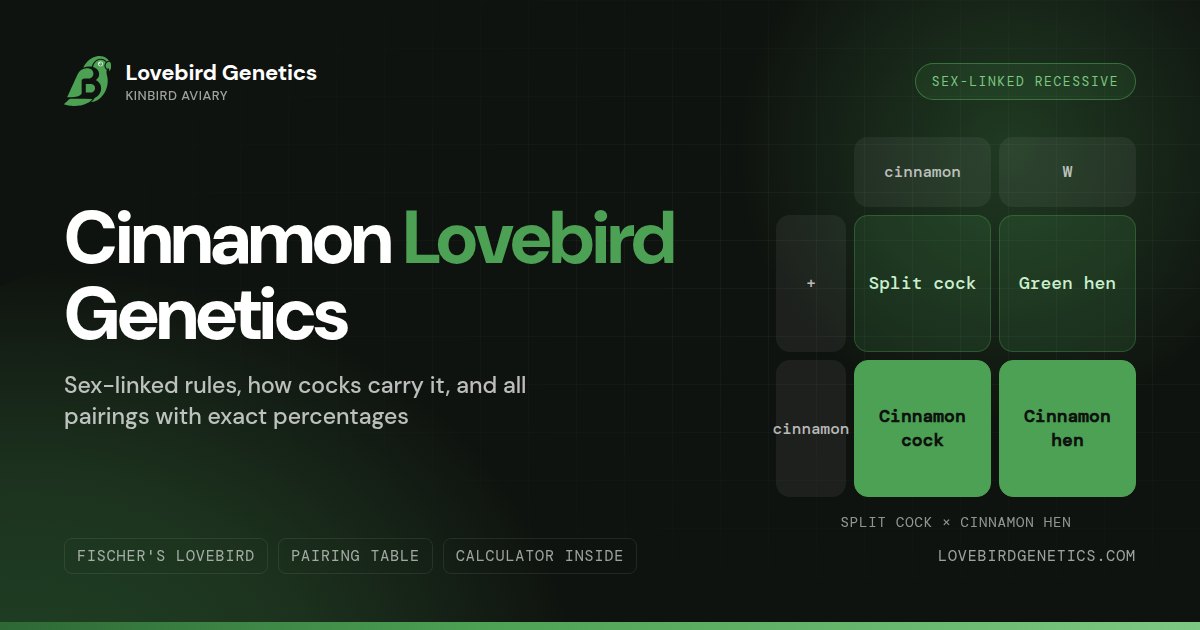
Cinnamon in Fischer's lovebirds is a sex-linked recessive mutation that replaces normal black-grey eumelanin with a warm brown (cinnamon-coloured) melanin via the TRP1 gene. Female Cinnamon birds cannot be splits, they are either visual or non-carrier. Cinnamon is best expressed in combination with Opaline and Pale Fallow for maximum breeder demand.
Cinnamon is a sex-linked recessive mutation. It is not black pigment turned brown; one step in the tyrosinase process is skipped, leaving incomplete brown eumelanin (the gene is believed to be TRP1). Chicks hatch with red eyes that darken to brown within days, and the birds are strong and vigorous. First recorded in the USA in the 1970s (Lovebird Compendium, pp. 408 to 417).
The TRP1 Gene, What Cinnamon Does to Melanin
Cinnamon in lovebirds is a sex-linked recessive mutation that turns the dark black markings a soft brown. The black pigment is made incompletely (the TRP1 gene), so it comes out brown rather than black. Chicks hatch with red eyes that darken within days, and the birds are strong and vigorous.
Cinnamon acts on the TRP1 gene and modifies only eumelanin, converting black-grey pigment into warm brown. It leaves psittacofulvin (the orange-red mask) and the structural blue-green base untouched. It layers most cleanly with non-eumelanin mutations such as Aqua, Opaline, or Yellow Face. Stack it with a second eumelanin reducer such as Pale Fallow or Dilute and you should expect the brown to wash out, which is the trade-off those combinations make (Van den Abeele, Lovebird Compendium, 2016).
Normal black-grey melanin (eumelanin) in Fischer's lovebirds is produced via a cascade of enzyme reactions, of which TYR (tyrosinase) and TRP1 (Tyrosinase-Related Protein 1) are the key steps. TRP1 functions as a DHICA oxidase, it catalyses the final polymerisation step of eumelanin synthesis, converting DHICA monomers into fully formed eumelanin polymer chains. This polymerisation step is what produces the deep black-grey colour of normal Fischer's eumelanin.
The Cinnamon mutation impairs TRP1 function. With TRP1 operating at reduced efficiency, the eumelanin synthesis pathway is diverted, instead of producing the standard black-grey eumelanin, the melanocytes produce a modified melanin that is warmer in colour, appearing brown rather than grey-black. The precise mechanism shifts the optical absorption profile of the pigment, so the feather reflects more red-brown wavelengths and fewer blue-black wavelengths. The visual result: everything that should be dark grey-black in a normal Fischer's lovebird becomes warm cinnamon-brown in a Cinnamon bird.
Critically, TRP1 operates in feather melanocytes specifically. The TYR enzyme and other pathways remain functional. This is why Cinnamon birds have normal psittacofulvin production (the orange-red face mask is unaffected) and normal foot colouration. Eye eumelanin is affected too, so chicks hatch plum-red and darken as eumelanin deposits, and adults read dark and often plum under a torch. The mutation is selectively expressed in the eumelanin that colours feather structures, specifically the wing bars, flight feathers, tail feathers, and all the areas that would normally be dark in a Fischer's lovebird. This mechanistic specificity, documented in Van den Abeele's Lovebird Compendium (2016), clearly distinguishes Cinnamon from Pale Fallow (which strips eumelanin far harder, roughly 90 to 95 percent, and leaves ruby eyes) and from Dilute (which affects melanosome size rather than melanin chemistry).
What Cinnamon looks like in Fischer's lovebirds
The Cinnamon mutation converts eumelanin, the pigment responsible for dark grey and black feathering, into a warm, brown-toned pigment via the TRP1 gene (Tyrosinase-Related Protein 1). The result is a bird where everything that should be dark is instead warm cinnamon-brown.
Key visual markers
The most reliable identification feature is the wing flight feathers. On a normal Fischer's lovebird they are dark grey with almost black vanes. On a Cinnamon bird, the flights are unmistakably warm brown, the colour of cinnamon spice. The tail feathers also show the same brown shift, and the beak horn is noticeably lighter than a wild-type bird, often appearing pale horn or straw-coloured when the bird is young.
The body colour itself becomes warmer. On Green Series Cinnamon birds, the olive-green tone becomes slightly more yellow-warm, and the mask edges soften from their usually sharp dark demarcation. On Blue 1 or Blue 2 Cinnamon birds, the cool turquoise body contrasts strikingly with the warm brown flights, one of the most visually distinctive looks in Fischer's mutations. Aqua Cinnamon takes this contrast even further, with the pale teal-green body set against rich cinnamon-brown feathers.
Chick identification
Cinnamon can be identified in newly hatched chicks before they are even feathered. Cinnamon chicks have a distinctly pinkish or flesh-coloured beak, compared to the dark grey beak of a Normal chick. This early identification is one of Cinnamon's practical advantages for breeders: you can often sex visually Cinnamon females from the moment they hatch, long before feathers develop, by combining beak colour observation with the auto-sexing rules covered below.
Look at the wing flight feathers: warm cinnamon-brown = Cinnamon mutation present. Dark grey or black = Normal. The beak horn and tail feathers confirm, they will also be brown-toned, not dark, on a Cinnamon bird.
The genetics: why females can't be splits
Cinnamon inheritance follows the same rules as the rest of the sex-linked recessive group in Agapornis fischeri, Opaline, Cinnamon and Pale, plus the not-yet-confirmed pallid phenotype. In birds, sex is determined by Z and W chromosomes, and this is the reverse of mammals:
- Males: ZZ, two Z chromosomes
- Females: ZW, one Z chromosome and one W chromosome
The Cinnamon gene sits on the Z chromosome. For a recessive gene to be hidden (a "split"), a bird needs two Z chromosomes, one carrying the Cinnamon allele and one carrying the Normal allele. The Normal allele masks the Cinnamon allele visually. This masking can only happen in males, who have two Z chromosomes.
Females have only one Z chromosome. Whatever Cinnamon allele is on that Z is expressed immediately, there is no second Z to hide behind. This is why female Fischer's lovebirds are always either Visual Cinnamon (they show the mutation) or Normal (they have no Cinnamon gene at all). A female bird described as "split for Cinnamon" does not exist and is a labelling error.
Males can be: Visual Cinnamon (ZCinZCin), Split Cinnamon (ZCinZN, looks normal), or Pure Normal (ZNZN).
Females can only be: Visual Cinnamon (ZCinW) or Normal (ZNW). There is no split for females.
This has enormous practical implications for how you plan pairings, evaluate birds for purchase, and interpret calculator results. Every pairing outcome must be read with sex in mind, unlike autosomal recessive mutations where outcomes are the same for both sexes.
All Cinnamon pairing outcomes
The five core Cinnamon pairings below cover every realistic breeding scenario. Each box separates sons and daughters because the outcomes differ by sex for every pairing.
| 1.0 Normal0.1 Visual Cinnamon | ||
|---|---|---|
| Offspring | Chance | Note |
| ♂Normal (split Cinnamon) | 50% | Looks completely normal, carries one Cinnamon Z from mom, one Normal Z from dad |
| ♀Normal (no Cinnamon gene) | 50% | Inherited dad's Z only. No Cinnamon carried at all |
All sons are split Cinnamon. All daughters are pure Normal. No visual Cinnamon chicks in this pairing, this is how breeders quietly introduce the Cinnamon gene into a Normal line.
Try this pairing →| 1.0 Normal (split Cinnamon)0.1 Normal | ||
|---|---|---|
| Offspring | Chance | Note |
| ♂Split Cinnamon male | 25% | Looks normal, carries one hidden Cinnamon Z |
| ♂Pure Normal male | 25% | No Cinnamon gene at all |
| ♀Visual Cinnamon female | 25% | Inherited dad's Cinnamon Z, expresses it fully |
| ♀Normal female | 25% | Inherited dad's Normal Z |
Half of all daughters will be Visual Cinnamon. The split male parent looks identical to a pure Normal, this is the pairing that confirms a split male's status when Visual Cinnamon daughters appear.
Try this pairing →| 1.0 Visual Cinnamon0.1 Normal | ||
|---|---|---|
| Offspring | Chance | Note |
| ♂Split Cinnamon male | 50% | Looks exactly like a Normal male, carries Cinnamon hidden |
| ♀Visual Cinnamon female | 50% | Expresses Cinnamon visually, inherited dad's Cinnamon Z |
Every Cinnamon chick is female. Every normal-looking chick is a split male. This is the classic Cinnamon auto-sexing pairing, sex can be determined visually from the nest box without DNA testing.
Try this pairing →| 1.0 Visual Cinnamon0.1 Visual Cinnamon | ||
|---|---|---|
| Offspring | Chance | Note |
| ♂Visual Cinnamon male | 50% | Homozygous ZCinZCin |
| ♀Visual Cinnamon female | 50% | |
100% Visual Cinnamon offspring regardless of sex. This is the fastest way to establish a full Cinnamon line but requires two visual parents, a Visual Cinnamon male is often harder to source than females.
Try this pairing →| 1.0 Normal (split Cinnamon)0.1 Visual Cinnamon | ||
|---|---|---|
| Offspring | Chance | Note |
| ♂Visual Cinnamon male | 25% | Homozygous, both Z chromosomes carry Cinnamon |
| ♂Split Cinnamon male | 25% | Looks normal but carries one Cinnamon Z |
| ♀Visual Cinnamon female | 25% | |
| ♀Normal female | 25% | No Cinnamon gene, inherited dad's Normal Z |
This pairing produces Visual Cinnamon males, the hardest sex to produce for a line that doesn't have them yet. Half the sons are visual and half are split, and half the daughters are visual.
Try this pairing →The auto-sexing advantage
Because Cinnamon sits on the Z chromosome and a hen is ZW with a single Z, she is either visual Cinnamon or carries nothing at all. A "split Cinnamon hen" is genetically impossible. This is exactly why a visual Cinnamon cock paired with a normal hen auto-sexes the clutch: every cinnamon-coloured chick is a daughter, every normal-looking chick is a split son (Van den Abeele, Lovebird Compendium, 2016).
Pairing 3 above, Visual Cinnamon male × Normal female, is the most practically useful Cinnamon pairing because it gives you free, reliable sex determination from the nest box. In a nest where both parents are confirmed as above, the rule is absolute:
- Every chick that shows Cinnamon colouring (warm brown flights, pale beak) is a female.
- Every chick that looks normal (dark grey flights, dark beak) is a split Cinnamon male.
There are no exceptions in a correctly confirmed pairing. This is possible because of the ZW sex determination system: all daughters inherit only the Cinnamon Z from their father (since he has ZCinZCin), while all sons inherit their father's Cinnamon Z plus the mother's Normal Z and are therefore split.
For breeders who produce large volumes of chicks and want to track sex without DNA testing or waiting for vent sexing confirmation, this pairing is hard to beat in practical terms. The offspring are also widely useful: split Cinnamon males are desirable breeding birds, and Visual Cinnamon females are popular with hobbyists.
Auto-sexing is only reliable when both parents are confirmed: the male must be a proven Visual Cinnamon (not just "probably Cinnamon") and the female must be a confirmed Normal (not an unknown that could be split-free but of uncertain background). A misidentified parent breaks the sex prediction entirely.
Cinnamon combined with other mutations
Newly hatched Cinnamon chicks show plum-red eyes that darken to a normal-looking brown within the first one to two weeks as eumelanin slowly deposits in the iris. This early eye colour, together with the pinkish beak, lets you flag Cinnamon in the nest box long before feathers appear. Do not mistake it for a Fallow or Ino mutation, whose eyes stay red into adulthood (Van den Abeele, Lovebird Compendium, 2016).
Cinnamon's warm brown tone interacts beautifully with the base colour series and with other mutations. Because Cinnamon is sex-linked, planning combination pairings requires thinking about sex at every step.
Cinnamon + Aqua
Aqua Cinnamon Fischer's lovebirds are among the most striking birds in the mutation spectrum. The Aqua mutation (autosomal recessive) gives the body a pale teal-green or mint colour. Adding Cinnamon converts the normally dark wing flights to warm cinnamon-brown, creating a contrast between the cool, soft body and the warm, rich flights. The effect is particularly pronounced in Aqua B2 Cinnamon and Aqua Homo Cinnamon, the paler the body, the more dramatic the warm/cool contrast.
To produce an Aqua Cinnamon female, you need a Cinnamon male (visual or split) crossed with an Aqua female, or both parents carrying Aqua in appropriate combinations. Because Cinnamon is sex-linked and Aqua is autosomal, the genetics must be planned across both systems simultaneously, the calculator handles this automatically when you set both mutations on the appropriate parent.
Cinnamon + Opaline
Both Cinnamon and Opaline are sex-linked recessive, which means they are both carried on the Z chromosome. A male bird can carry both simultaneously, written as a "double sex-linked" bird. A Cinnamon Opaline male has both mutations on his Z chromosomes in some arrangement, and the combined visual effect is a bird with Opaline's rich colour redistribution plus Cinnamon's warm brown feathering, particularly warm, saturated, and unusual-looking.
Producing double sex-linked birds requires careful pairing planning. A useful starting point is a Visual Opaline male paired with a Visual Cinnamon female. Their sons will be split for both Opaline and Cinnamon, and from those sons, further pairings can combine the mutations into homozygous double sex-linked males and females expressing both mutations.
Cinnamon + Pale Fallow
Pale Fallow is autosomal recessive, meaning both males and females can be splits. Cinnamon Pale Fallow is a warm, diluted bird where Pale Fallow's pale body and red eye combine with Cinnamon's brown feathering. The Pale Fallow body colour is already yellowish-cream, and Cinnamon softens the feather darkness further, creating an extremely pale, warm-toned bird with red eyes and cinnamon-coloured flight feathers. This combination is relatively uncommon and is in strong demand where available.
Cinnamon + Dark Factor
Dark Factor is autosomal dominant incomplete, so it can combine with Cinnamon in both sexes without any special sex-linked considerations. Cinnamon Single Factor Dark (dark green Cinnamon) shows deepened body colour with the warm brown flights, a more forest-toned bird than standard Cinnamon Green. Double Factor Cinnamon (olive-coloured body with warm feathers) is unusual and less common.
Plan your Cinnamon pairings
Set Cinnamon on the correct sex and see exact offspring percentages by sexReading the calculator for Cinnamon
The Lovebird Genetics Calculator handles Cinnamon's sex-linked inheritance automatically, but you need to enter the birds correctly. Here is the exact process:
- For males: set the Cinnamon toggle to Visual (if the male shows Cinnamon), Split (if he looks normal but is a known carrier), or leave it off (pure Normal with no Cinnamon gene).
- For females: set the Cinnamon toggle to Visual (if she shows Cinnamon) or leave it off (she is Normal and has no Cinnamon gene). The Split option for females is intentionally disabled, it does not exist for sex-linked mutations in females.
- Read the results by sex. Unlike autosomal mutations where every row applies to any offspring, Cinnamon results are split into male and female rows. The percentage shown is the probability for that specific sex among all offspring of that sex, not among all offspring total.
The most common mistake is setting a female parent to "Split for Cinnamon", this produces incorrect offspring calculations. If you purchased a female advertised as "split Cinnamon" it is a mislabelled bird; enter it as either Visual Cinnamon or Normal in the calculator, depending on its actual appearance.
When combining Cinnamon with AR mutations like Aqua, set both systems independently. The calculator multiplies the probabilities correctly: if a pairing gives 50% Cinnamon daughters and 25% Aqua offspring, it will correctly show that Aqua Cinnamon daughters appear in 12.5% of all offspring (50% × 25% = 12.5%).
Cinnamon vs Dilute, Clearing Up the Confusion
Many Fischer's lovebird breeders, particularly newcomers, confuse Cinnamon and Dilute because both produce lighter-looking birds. The two mutations are distinct in mechanism, inheritance type, and visual markers. Getting them confused has real breeding consequences: labelling a Dilute bird as a Cinnamon (or vice versa) misrepresents how it will breed entirely, since the two mutations have completely different sex-linked vs autosomal inheritance.
Inheritance Type, The Fundamental Difference
Cinnamon is sex-linked recessive (SL): it is carried on the Z chromosome. Females cannot be splits, they are either visual or non-carrier. Males can be split, visual, or non-carrier. Dilute is autosomal recessive (AR): it is carried on an autosome (non-sex chromosome). Both males and females can be splits, visuals, or non-carriers. The inheritance type alone determines the entire breeding programme, pairing rules, offspring sex ratios, and breeder demand of splits all differ between the two. See the Dilute lovebird genetics guide for the full Dilute breakdown.
Molecular Mechanism
Cinnamon changes the type of melanin produced, from black-grey eumelanin to warm brown melanin, via the TRP1 pathway. Dilute changes the quantity of melanin deposited per feather, normal eumelanin is produced, but oversized melanosomes (macromelanosomes) result in less melanin per unit area of feather. The underlying melanin chemistry is different: in Cinnamon the pigment is chemically brown; in Dilute the pigment is chemically the same dark grey as Normal but physically present in smaller amounts.
Visual Diagnostic Under Natural Light
Wing bar colour is the primary field diagnostic. Cinnamon birds have unmistakably warm brown wing bars, the colour of cinnamon spice, with clear red-brown undertones. Dilute birds have pale grey wing bars, the same grey as Normal Fischer's wing bars, just lighter and less saturated. Under direct sunlight, a person with basic colour discrimination can reliably separate the two. In poor indoor lighting, both mutations can look similarly "pale" and be confused. Eye colour in both Cinnamon and Dilute birds is normal dark brown as adults; cinnamon chicks hatch plum-red. That is unlike the Fallow mutations, which alter adult eye colour. Foot colour is also normal in both.
How to Confirm in the Absence of Pedigree
If you have a bird of uncertain mutation history that looks pale, the wing bar colour test under natural light is the first step. Warm brown wings = likely Cinnamon. Pale grey wings = likely Dilute. Confirm by test pairing: pair the bird with a confirmed Normal female (for a suspected Cinnamon male). If Cinnamon daughters appear, the male is at minimum split for Cinnamon. A Dilute male paired with a Normal female will produce all normal-looking offspring (all splits for Dilute) with no visual result in the first generation, which is also informative. Use the Lovebird Genetics Calculator to plan confirmation pairings before committing breeding season resources.
Cinnamon in Combination, Full Guide
Because Cinnamon is sex-linked, planning combination pairings requires thinking about sex at every step. The combinations below represent the most widely relevant Cinnamon combination birds in 2026 markets.
Cinnamon Opaline, The Premier Sex-Linked Stack
Both Cinnamon and Opaline are sex-linked recessive, carried on the Z chromosome. This means a single male bird can carry both mutations simultaneously on the same or different Z chromosomes. A male carrying both Cinnamon and Opaline on his Z chromosomes (in cis, on the same chromosome) passes both mutations together as a linked unit to half his daughters. The result is Cinnamon Opaline females who show both the warm brown feather quality of Cinnamon and the plumage redistribution and psittacofulvin intensification of Opaline simultaneously.
Cinnamon Opaline females are among the most aesthetically distinctive Fischer's lovebirds in the sex-linked mutation category. The Opaline redistribution creates richer colour areas across the mantle and wings; the Cinnamon brown converts all dark feather edges and flight feathers from grey-black to warm brown, creating a soft, warm, richly feathered visual. Confirmed Cinnamon Opaline females are highly sought after. A Cinnamon Opaline male (homozygous for both sex-linked mutations) is especially prized as a breeding bird due to his ability to reliably pass both mutations to all daughters.
Breeding note: a male carrying Cinnamon on one Z and Opaline on the other Z (in trans) is a split for each mutation separately, but is NOT a Cinnamon Opaline combination in the sense of producing combination offspring reliably. He will produce some Cinnamon daughters and some Opaline daughters, but Cinnamon Opaline daughters require both mutations on the same Z from the father. Tracking which arrangement applies requires careful pedigree analysis or test pairings.
Cinnamon Pale Fallow, Double Melanin Reduction
Cinnamon (sex-linked, TRP1 pathway) and Pale Fallow (autosomal recessive, a strong eumelanin reduction of roughly 90 to 95 percent with ruby eyes) affect melanin through two independent genes. Stacking both creates a bird with dramatically reduced melanin on two fronts: the Cinnamon gene shifts the melanin type to warm brown, and Pale Fallow strips most of the remaining quantity. The resulting bird has very pale, warm-toned plumage with the characteristic pink-red eyes of Pale Fallow, a striking combination that is widely rare and is in strong demand.
Because Cinnamon is sex-linked and Pale Fallow is AR, producing Cinnamon Pale Fallow females requires: a father who is Visual Cinnamon (or split Cinnamon) AND split or visual for Pale Fallow, paired with a mother who is split or visual for Pale Fallow. Multi-generation planning is required.
Cinnamon Aqua, Cool Body, Warm Wings
The Aqua mutation (autosomal recessive) gives the body a pale teal-green or mint colour. Adding Cinnamon converts the normally dark wing flights to warm cinnamon-brown, creating a vivid warm/cool contrast between the body and wings. The effect is particularly pronounced in Aqua Homo Cinnamon, the paler the Aqua body (Homo Aqua is lighter than B1 or B2 Aqua), the more dramatic the cinnamon-brown feathers stand out.
Cinnamon Opaline Pale Fallow, Triple Combination
Stacking all three mutations, Cinnamon (SL), Opaline (SL), and Pale Fallow (AR), produces a prestige bird that is extremely rare in established lines. The warm Cinnamon brown feathers, the Opaline redistribution of psittacofulvin, and the Pale Fallow pink-red eyes combine for a bird that is unlike any other Fischer's mutation. Multi-generation breeding programmes are required to reliably produce this combination.
Cinnamon + Dark Factor
Dark Factor is autosomal dominant incomplete, so it can combine with Cinnamon in both sexes without any sex-linked complications. Cinnamon Single Dark (Cinnamon Dark Green) shows deepened body colour with warm brown flights, a more richly toned bird than standard Cinnamon Green. The darker body makes the cinnamon-brown flight feathers appear even warmer by contrast.
How Rare Is Cinnamon, and What Should You Look for in Breeding Stock?
As a single mutation, Cinnamon is fairly common and easy to establish. Its scarcity, and the demand that follows, lives almost entirely in its combinations: Cinnamon Opaline, Cinnamon Aqua, and the rarer triple stacks take real generations to build, which is what keeps them sought-after.
The breeding difficulty is not in producing Cinnamon itself but in steering its sex-linked inheritance toward the combination you want. Because Cinnamon sits on the Z chromosome, the sex of every chick changes what the pairing can produce. A Visual Cinnamon male is the genuinely scarce piece in most lines, because the quickest routes to Cinnamon, the auto-sexing pairings, throw all their Cinnamon into daughters and leave the sons as splits. Producing Visual Cinnamon males takes a Visual Cinnamon female paired back to a split or visual male, and stacking a second sex-linked mutation like Opaline onto the same Z compounds the difficulty further. A double sex-linked male carrying both Cinnamon and Opaline in cis is the linchpin of a combination programme, and reaching one reliably is a multi-generation effort that rewards careful pedigree tracking far more than luck.
When selecting Cinnamon stock, examine the wing flight feathers in natural daylight first: a true, warm cinnamon-brown flight confirms the mutation and separates it cleanly from the pale grey of Dilute, which is the most common misidentification. Favour birds with even, well-saturated brown tone and clean feather quality over washed-out or patchy examples, because consistent pigment expression is what carries through into the striking combination birds. For sex-linked planning, documented parentage matters more than appearance: a split Cinnamon male is only useful to your programme if his carrier status is recorded, since he is visually identical to a pure normal. The most useful founders are confirmed Visual Cinnamon females and well-documented split males, ideally ones that already carry a second mutation such as Aqua or Opaline, because they shorten the path to the combination birds that hold the real demand.
Common Mistakes with Cinnamon
Several recurring errors appear across South Asian Fischer's breeding communities when working with Cinnamon:
- Calling a Dilute bird "Cinnamon." They look similar at a glance, both produce lighter-looking Fischer's lovebirds. But the wing bar colour (warm brown vs pale grey) and inheritance type (sex-linked vs autosomal recessive) are different. Misidentification leads to incorrect pairing calculations and mislabelled birds. Always check wing bar colour under natural light before labelling.
- Selling a "split Cinnamon female." Genetically impossible. Females are ZW, they cannot carry a Z-linked mutation as a hidden split. A female is either Visual Cinnamon (the mutation is expressed) or Normal (no Cinnamon gene). If a seller offers you a "split Cinnamon female," the bird has been mislabelled. Buy it as a visual or as a Normal, or request a DNA test to confirm which applies.
- Assuming Cinnamon + Opaline = automatic combination in all offspring from a double sex-linked male. A male carrying Cinnamon on one Z and Opaline on the other Z (in trans) is not the same as a male carrying both on the same Z (in cis). The in-trans male produces some Cinnamon daughters and some Opaline daughters, but Cinnamon Opaline daughters are rarer and require specific arrangements. Verify which Z arrangement your breeding male carries before projecting Cinnamon Opaline daughter output.
- Expecting Cinnamon to produce dramatically different results on a green base vs blue base visually. Unlike Violet, which looks completely different on green vs blue, Cinnamon's warm brown wing bars are visible on any base colour. The wing bar colour is the consistent diagnostic regardless of whether the bird is Green, Blue, or Aqua series. The body colour appearance does shift (greener on green, more teal on Aqua), but the wing bar diagnostic remains constant.
History and Origin of Cinnamon in Fischer's Lovebirds
Cinnamon is documented in Van den Abeele's Lovebird Compendium (2016) as a sex-linked recessive mutation in Agapornis fischeri, with the TRP1 gene identified as the molecular basis for the melanin shift from black-grey eumelanin to warm brown. The mutation belongs to the sex-linked recessive group in Agapornis fischeri, Opaline, Cinnamon and Pale, plus the not-yet-confirmed pallid phenotype. Cinnamon was first recorded in the USA in the 1970s.
The Cinnamon mutation name derives directly from the warm brown wing bar colouration characteristic of affected birds, the colour is a near-exact visual match to cinnamon spice under natural lighting. This naming convention is consistent across most major Fischer's aviculture communities globally, although some older European literature refers to the same mutation as "Cinnamon" or "Zimmtfarben" in German-language aviculture texts.
In South Asian aviculture (Bangladesh, Pakistan), Cinnamon draws interest primarily in combination. As a single mutation it is only a modest step up in demand from normal green birds. The combination appeal, particularly with Opaline, has been the primary driver of breeding interest in Cinnamon since the mutation became established in South Asian Fischer's collections in the 2000s and 2010s.
The Fischer's lovebird (Agapornis fischeri), as documented by BirdLife International, is native to the interior of Tanzania and was first described scientifically in the late 19th century. Its popularity in aviculture, and the resulting accumulation of colour mutations, has made it one of the most genetically diverse parrot species in captive breeding programmes globally. Cinnamon represents one of the sex-linked mutations that gives breeders the practical advantage of automatic sex determination from the nest, a feature unique to the sex-linked recessive inheritance class.
For the complete context on sex-linked mutation inheritance in Fischer's lovebirds, including how Cinnamon compares to Opaline and Pallid, see the sex-linked mutations overview guide.
References
- Van den Abeele, D. (2016). Lovebird Compendium. Ornitho-Media. ISBN 978-90-822990-0-3.
- Wikipedia contributors. Lovebird. Wikipedia, The Free Encyclopedia. Accessed 2026.
- BirdLife International. Agapornis fischeri, Fischer's Lovebird. BirdLife Species Factsheet. Accessed 2026.
Cinnamon pairing outcomes, cock × hen
Breeders usually describe a pairing as cock × hen. Below is every common Cinnamon pairing written that way, with the exact percentages this calculator produces.
What do you get from a Cinnamon cock x normal hen?
Every son is a normal-looking split Cinnamon cock and every daughter is a visual Cinnamon hen. This is the classic auto-sexing pairing: you can sex the chicks by colour alone, with no DNA test.
| Chicks | Outcome |
|---|---|
| Sons | 100% normal / split Cinnamon |
| Daughters | 100% visual Cinnamon |
What do you get from a normal cock x Cinnamon hen?
Every son is a split Cinnamon cock and every daughter is a normal hen. No visual Cinnamon chicks are produced in this direction, which is why the sex of the Cinnamon parent decides everything.
| Chicks | Outcome |
|---|---|
| Sons | 100% normal / split Cinnamon |
| Daughters | 100% normal |
What do you get from a split Cinnamon cock x normal hen?
Half the daughters come out visual Cinnamon. Sons are split or normal in equal share and look identical, so only a test pairing or pedigree tells them apart.
| Chicks | Outcome |
|---|---|
| Sons | 50% split Cinnamon, 50% normal |
| Daughters | 50% visual Cinnamon, 50% normal |
What do you get from a split Cinnamon cock x Cinnamon hen?
This pairing produces visual Cinnamon in both sexes. Half the sons are visual Cinnamon and half are split, while half the daughters are visual Cinnamon.
| Chicks | Outcome |
|---|---|
| Sons | 50% visual Cinnamon, 50% split Cinnamon |
| Daughters | 50% visual Cinnamon, 50% normal |
What do you get from a Cinnamon cock x Cinnamon hen?
Every chick of both sexes is a visual Cinnamon. Nothing is hidden and no splits are produced, which makes this the fastest way to fix the mutation in a line.
| Chicks | Outcome |
|---|---|
| Sons | 100% visual Cinnamon |
| Daughters | 100% visual Cinnamon |
Run any of these in the lovebird genetics calculator to see the full offspring list for your own birds.
Frequently asked questions
What is Cinnamon in Fischer's lovebirds?
Cinnamon is a sex-linked recessive mutation in Agapornis fischeri that modifies eumelanin (the dark brown/black pigment) through the TRP1 gene. Affected birds show warm cinnamon-brown wing flights, tail feathers, and beak horn instead of the normal dark grey or black. The body colour softens to a warmer, more olive or golden tone depending on the base colour series.
Can female cinnamon lovebirds be split?
No. Cinnamon is sex-linked recessive, carried on the Z chromosome. Female Fischer's lovebirds are ZW, they have only one Z chromosome. Whatever gene is on that Z is expressed immediately, so females are either Visual Cinnamon (they show it) or Normal (they don't carry it). A female "split for Cinnamon" does not exist. Only males (ZZ) can carry Cinnamon as a hidden split.
What does cinnamon male × normal female produce?
This is the classic auto-sexing pairing. All sons are split Cinnamon (look completely normal) and all daughters are Visual Cinnamon. Sex can be read from the nest box: every Cinnamon-coloured chick is female, every normal-looking chick is a split male. No DNA testing or vent sexing needed.
How do you identify a cinnamon lovebird visually?
The most reliable marker is the wing flight feathers, they are warm cinnamon-brown instead of dark grey or black. The tail feathers and beak horn are also browner than a Normal bird. In newly hatched chicks, Cinnamon chicks have a noticeably pinkish or flesh-coloured beak compared to the dark grey beak of Normal chicks. The body colour is warmer overall, with a more olive or golden cast on Green Series birds. On Blue Series or Aqua birds, the Cinnamon creates a striking contrast between the cool blue body and the warm brown feathers.
Is Cinnamon lovebird the same as Opaline?
No. Both are sex-linked recessive in Fischer's lovebirds but they affect completely different aspects of pigmentation. Cinnamon modifies eumelanin (dark pigment) via the TRP1 gene, creating warm brown tones throughout. Opaline redistributes psittacine pigment (the colour pigment), creating richer saturation and a characteristic gradient pattern on the wing feathers. A bird can carry and express both simultaneously, Cinnamon Opaline, which creates a distinctive warm, richly coloured visual.
What is a Cinnamon Aqua lovebird?
Cinnamon Aqua is a compound Fischer's lovebird that expresses both the Cinnamon mutation (sex-linked recessive) and the Aqua mutation (autosomal recessive). The body is pale teal-green or mint (from Aqua) while the wing flights are warm cinnamon-brown (from Cinnamon) instead of dark. The cool/warm colour contrast is visually striking. Producing Cinnamon Aqua females requires a Cinnamon male (visual or split) combined with Aqua parents on both sides.
How do I confirm a lovebird is split for Cinnamon?
Only cocks can be split for Cinnamon, a hen is either visual Cinnamon or carries nothing. Two methods confirm a split cock: test pairing or DNA testing. For a test pairing, breed the suspected split male with a Normal female. If any daughters are Visual Cinnamon, the male is confirmed to carry the Cinnamon gene. If all daughters are Normal after several clutches, the evidence grows against him being split, but is not conclusive without DNA. DNA testing from a feather or blood sample is definitive and does not require waiting for offspring.
Can I use the Cinnamon auto-sexing trick with Blue or Aqua birds?
Yes. The auto-sexing rule (Visual Cinnamon ♂ × Normal ♀ → all Cinnamon chicks are female) applies regardless of the base colour. A Visual Cinnamon Aqua male paired with a Normal Aqua female will produce Cinnamon Aqua daughters and split Cinnamon Aqua sons, all identifiable by wing flight colour from the nest. The base colour series does not affect the sex-linked inheritance pattern.
Why is a split Cinnamon male useful in a breeding programme?
A split Cinnamon male looks identical to a pure normal but carries one hidden Cinnamon Z, so he can produce Visual Cinnamon daughters when paired with a Normal female. This makes documented split males the quiet workhorses of a Cinnamon line, because they let you introduce or expand the mutation without needing a visual male on hand. The most sought-after splits are those with verified parentage and those that also carry other mutations, such as split Cinnamon split Aqua, since they let a breeder build combination birds in fewer generations.
What do you get from a Cinnamon cock x normal hen?
Every son is a normal-looking split Cinnamon cock and every daughter is a visual Cinnamon hen. This is the classic auto-sexing pairing: you can sex the chicks by colour alone, with no DNA test. Sons: 100% normal / split Cinnamon; Daughters: 100% visual Cinnamon.
What do you get from a normal cock x Cinnamon hen?
Every son is a split Cinnamon cock and every daughter is a normal hen. No visual Cinnamon chicks are produced in this direction, which is why the sex of the Cinnamon parent decides everything. Sons: 100% normal / split Cinnamon; Daughters: 100% normal.
What do you get from a split Cinnamon cock x normal hen?
Half the daughters come out visual Cinnamon. Sons are split or normal in equal share and look identical, so only a test pairing or pedigree tells them apart. Sons: 50% split Cinnamon, 50% normal; Daughters: 50% visual Cinnamon, 50% normal.