
Blue 1 (B1, the bl1 allele): Homozygous B1/B1, classic blue bird, white face, no psittacofulvin
Blue 2 (B2, the bl2 allele): Homozygous B2/B2, similar appearance to B1, subtle differences
Parblue: The allelic compound B1 // B2 (bl1 // bl2), intermediate phenotype, blue-green body with pale face. Neither fully blue nor green.
Notation used here: a single slash means a split (Green / Blue 1) or a homozygote (B1/B1). A double slash means an allelic compound, two different alleles of the same gene that both express (B1 // B2).
The Blue mutation is a complete psittacine reduction: it removes all yellow pigment so the bird turns pure blue. Van den Abeele records the first blue lovebird in Agapornis personatus, from a 1927 shipment out of Tanganyika (now Tanzania) to England. Blue type 1 and Blue type 2 are separate alleles of the same blue (bl) locus, which is why they combine into Parblue rather than blending (Lovebird Compendium, pp. 284 to 295).
What Does the Blue Mutation Do?
The blue mutation in lovebirds is an autosomal recessive mutation that removes all of the yellow psittacine pigment, leaving only the feather's structural blue, so a green bird becomes pure blue with a white mask. Blue type 1 and Blue type 2 are separate alleles of the same blue locus.
In wild-type Fischer's lovebirds, the green body colour comes from two systems working together: a structural blue, produced when the spongy layer inside each feather barb scatters short-wavelength light over a dark eumelanin backing, and psittacofulvins, which overlay yellow on top and read as green in combination with that blue. Eumelanin does not itself produce the blue, it is the dark underlayer that absorbs the light the spongy zone does not scatter, without which the blue would look washed out. The orange-red face comes from high concentrations of psittacofulvins in the head feathers.
The Blue mutation disrupts the psittacofulvin production pathway, eliminating the yellow-red pigment from the plumage entirely. The result: the structural blue-green colour is revealed without any yellow overlay. Body becomes blue-green to cobalt, and the face becomes white or very pale because there is no orange-red psittacofulvin left to produce the mask colour.
The psittacofulvin pathway in detail
Psittacofulvins are pigments unique to parrots, they are produced nowhere else in the animal kingdom. In Fischer's lovebirds, psittacofulvins create the orange-red face mask and the yellow underlayer of the green body. The green body colour is not a single pigment: it is the visual result of psittacofulvins (yellow) layered over structural colour produced by the feather microstructure (blue). Remove the psittacofulvins, and the structural blue is revealed, which is exactly what the Blue mutation does.
All of the psittacofulvin-reduction variants in Fischer's lovebirds sit at one gene, the blue (bl) locus, and they form an allelic series. The wild-type allele allows full psittacofulvin deposition and is dominant over every other member of the series. Below it sit aqua (roughly 50 percent reduction) and the two full-reduction alleles bl1 (Blue 1) and bl2 (Blue 2), so the fischeri series reads wild-type, blue 1, blue 2, aqua. The 2016 Lovebird Compendium classified the early yellow-masked fischeri as turquoise, but the Ornitho-Genetics VZW Agapornis mutation list updated 17 August 2025 no longer records turquoise in this species. No gene name has been assigned to this locus in lovebirds by the Compendium or by Ornitho-Genetics VZW, so it is described by its position and behaviour rather than by a named gene.
Because there is only one locus, a bird carries at most two of these alleles, one on each chromosome. Two copies of the same full-reduction allele give a pure Blue. Two different alleles of the series give an allelic compound in which both express, and the phenotype lands between them. That is why Parblue (B1 // B2) birds have pale yellow faces rather than pure white faces: the compound still allows partial psittacofulvin deposition, enough to produce a faint warm yellow on the high-concentration face feathers, while the body, where psittacofulvin density is lower, reads as turquoise-blue. The same logic produces Aqua B1 (aqua // bl1) and Aqua B2 (aqua // bl2).
Blue 1 (B1)
Homozygous for the B1 allele. Classic Blue Fischer's, white face, cobalt-blue to blue-green body. Fully eliminates psittacofulvin.
Genotype: B1/B1Blue 2 (B2)
Homozygous for the B2 allele. Very similar to B1 visually. B2 and B1 birds look almost identical without genetic testing or breeding records.
Genotype: B2/B2Parblue
Carries one B1 and one B2 allele, an allelic compound rather than a split. Shows an intermediate phenotype, partial blue expression. Blue-green body, pale yellowish face. Visually distinct from pure Blue.
Genotype: B1 // B2How the Blue mutation works, in plain terms
A green lovebird is really structural blue with a yellow pigment filter laid over it. The Blue mutation removes all of the yellow pigment (a complete psittacine reduction), so only the structural blue is left and the bird turns pure blue with a white mask. That is the difference from aqua, which removes only about half the yellow and lands on turquoise. Blue type 1 and Blue type 2 are two separate alleles of the same blue locus, which is why combining them gives Parblue rather than a blend (Van den Abeele, Lovebird Compendium, pp. 284 to 295).
Why Does B1 × B2 Produce Parblue?
Blue 1 and Blue 2 are two separate alleles at the same blue-locus gene position, not a single mutation. Each carries one allele from each parent, so a B1 visual paired with a B2 visual gives every chick one B1 and one B2: the result is 100% Parblue and never a single pure Blue. Pure Blue, by contrast, is the full psittacine reduction state that needs two copies of the same allele (Van den Abeele, Lovebird Compendium, 2016).
This is the question that confuses most breeders. If both B1 and B2 produce blue birds when homozygous, why does combining them produce something different?
The answer lies in how the two alleles interact. B1 and B2 are different alleles of the same gene, the blue (bl) locus, and they reduce psittacofulvin in slightly different ways. When a bird carries one copy of each (B1 // B2), neither allele is dominant over the other, so both express. The result is a bird that shows partial psittacofulvin reduction, not zero (like pure Blue) and not full (like Green), but somewhere in between. This intermediate expression is Parblue, and it is a co-dominant allelic compound, not a split.
This is different from how simple recessive inheritance works. Against the wild-type green allele, which is dominant over the whole series, one copy of B1 gives a normal-looking green carrier written Green / Blue 1. But put B1 opposite B2 rather than opposite wild-type and there is no working allele left to mask anything, so a B1 // B2 bird shows the partial effect directly.
Parblue and Aqua both produce turquoise or blue-green birds, and they are frequently confused. They are different allele combinations at one and the same gene, the blue (bl) locus. Parblue is bl1 // bl2. Aqua uses a third allele of that series, so Aqua B1 is aqua // bl1, Aqua B2 is aqua // bl2 and Aqua Homo is aqua / aqua. A Parblue bird paired with another Parblue will NOT produce Aqua birds, not because the genes differ but because neither parent carries an aqua allele to pass on. You cannot convert between them through breeding without introducing the aqua allele from outside the line.
Core Blue Pairings
| 1.0 Blue 1 (B1/B1)0.1 Blue 2 (B2/B2) | ||
|---|---|---|
| Offspring | Chance | Note |
| Parblue (B1 // B2) | 100% | All chicks get one B1 from father, one B2 from mother |
| 1.0 Parblue (B1 // B2)0.1 Parblue (B1 // B2) | ||
|---|---|---|
| Offspring | Chance | Note |
| Blue 1 (B1/B1) | 25% | Pure Blue 1 homozygous |
| Parblue (B1 // B2) | 50% | Intermediate phenotype |
| Blue 2 (B2/B2) | 25% | Pure Blue 2 homozygous |
| 1.0 Blue 1 (B1/B1)0.1 Normal green | ||
|---|---|---|
| Offspring | Chance | Note |
| Split Blue 1 (Green / Blue 1) | 100% | All chicks carry one B1, look green, breed blue |
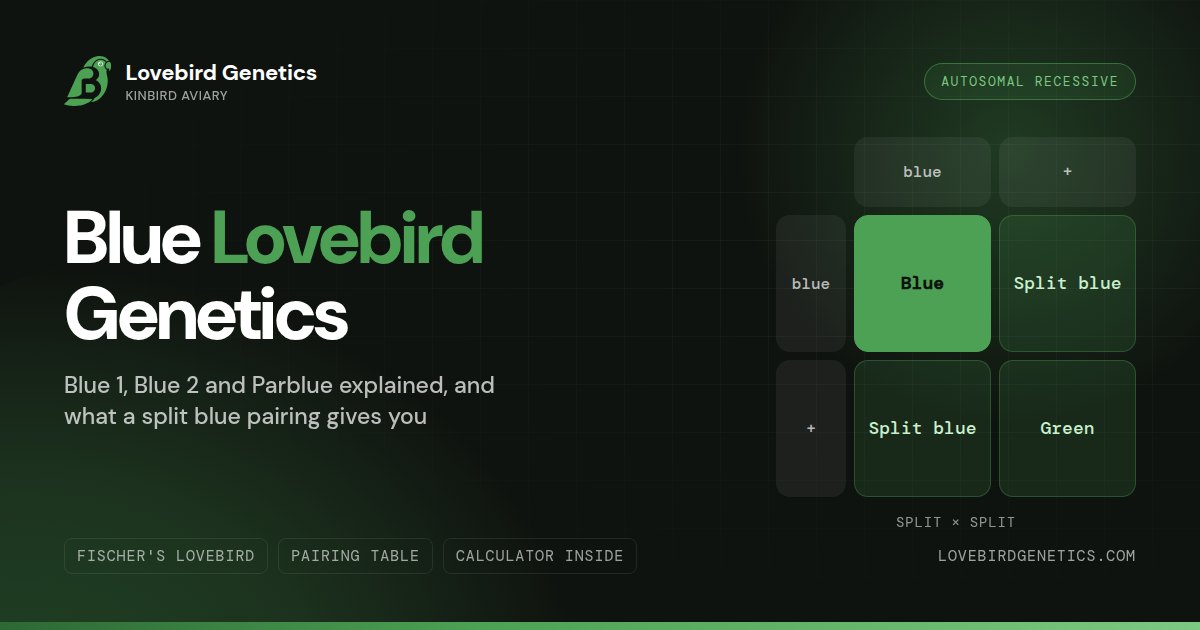
| 1.0 Normal / Blue 1 split0.1 Normal / Blue 1 split | ||
|---|---|---|
| Offspring | Chance | Note |
| Blue 1 visual (B1/B1) | 25% | Shows full blue phenotype |
| Split Blue 1 (Green / Blue 1) | 50% | Looks green, carries B1 |
| Normal non-carrier | 25% | No Blue gene |
Calculate your Blue or Parblue pairing
Combine with Opaline, YF, Violet, and moreBlue vs Aqua: Key Differences
Blue and Aqua are not separate genes. They are alleles of the same gene, the blue (bl) locus, so in Fischer's lovebirds that series is the dominant wild-type, blue 1, blue 2 and aqua. They reduce psittacine pigment to different degrees, so they look different, but they occupy the same position on the chromosome and a bird can only carry two of them. That is why a Parblue paired with a Parblue can only ever throw Blue-series birds and never Aqua: neither parent holds an aqua allele in either slot, so neither can pass one on (Van den Abeele, Lovebird Compendium, 2016).
Because Parblue and Aqua look similar, both turquoise-ish, both departures from green, they are among the most commonly confused birds in the hobby. Here is the definitive comparison, remembering throughout that both are combinations drawn from the same allelic series:
| Feature | Parblue (B1 // B2) | Aqua (aqua // bl1, aqua // bl2, aqua / aqua) |
|---|---|---|
| Gene locus | Blue (bl) locus, the bl1 and bl2 alleles | The same blue (bl) locus, using the aqua allele |
| Face mask | Pale / yellowish-white | Faded toward light pink |
| Body colour | Blue-green, more blue-ish | Turquoise / sea-green |
| Produced by | Blue 1 × Blue 2, or Parblue × Parblue | Any pairing where both parents carry an aqua allele |
| Homozygous form | bl1 / bl1 = Blue 1, bl2 / bl2 = Blue 2 | aqua / aqua = Aqua Homo, deeper turquoise |
| Can produce Aqua? | No, a Parblue holds bl1 and bl2 in its two slots, so it has no aqua allele to pass on | Yes, whenever both parents carry the aqua allele |
Identifying Blue Fischer's Lovebirds Visually
Accurate visual identification of Blue, Parblue, and their splits is one of the most practically important skills in Fischer's lovebird breeding. The differences between B1, B2, and Parblue are subtle enough that new breeders often mislabel birds, which compounds across generations into serious pedigree errors. Here is a definitive breakdown.
Pure Blue 1 (B1/B1), homozygous
A homozygous B1 Fischer's lovebird shows complete psittacofulvin elimination. The face mask loses all orange and red pigment, becoming white or very pale pinkish-white in good light. The body is a clean, cool blue-green, noticeably cooler in tone than Aqua birds. The blue sits firmly in the blue-grey range with no suggestion of turquoise warmth. The feet remain the standard grey-pink colour, and the eyes remain normal dark brown. B1/B1 birds often appear slightly lighter in overall tone than B2/B2 birds under the same lighting.
Pure Blue 2 (B2/B2), homozygous
Homozygous B2 birds look similar to B1/B1 at a casual glance, but experienced breeders note a slightly different quality of blue, often marginally deeper or with a faint warm undertone. The face mask is equally white and psittacofulvin-free. One practical way to distinguish B1/B1 from B2/B2 in a collection is to pair them: if the offspring are all Parblue (B1 // B2), the parents were homozygous for different alleles. If offspring include B1 and B2 alongside Parblue, at least one parent was heterozygous. Direct visual distinction is unreliable, pedigree and test pairings are the only certain route.
Parblue (B1 // B2), compound heterozygote
The Parblue bird is immediately recognisable once you know what to look for. The face mask is not pure white, it retains a distinct pale yellow or yellowish-cream tone. This is because the B1 // B2 combination only partially suppresses psittacofulvin production, leaving a residual warm pigment that reads as yellow on the face. The body colour is a blue-green that sits warmer and more turquoise than a pure Blue, visually somewhere between full blue and Aqua, and produced by a different pair of alleles drawn from the same blue-locus series. Under natural light, Parblue birds have a distinctive soft glow that makes them easy to distinguish from pure Blues once you have seen both side by side.
Splits for Blue, visual confirmation is impossible
A bird split for B1 (Green / Blue 1) or split for B2 (Green / Blue 2) shows no visual difference from a fully normal green Fischer's lovebird. The face mask is full orange-red. The body is standard green. Eye colour, foot colour, and feather structure are all unchanged. The only reliable confirmation methods are: confirmed pedigree records showing at least one Blue parent, DNA testing from a certified avian genetics laboratory, or test pairings (pairing the suspected split with a confirmed Blue bird and observing offspring).
Why Is Parblue Harder to Establish Than Pure Blue?
Pure Blue is one of the more accessible mutations to breed because it is autosomal recessive and only needs two copies of a single allele. Parblue is harder because it depends on two different alleles, B1 and B2, both present in the same line. Sourcing and consolidating both is the real difficulty.
The bottleneck is that B2 appears less frequently in many Asian collections than B1. A breeder who already keeps Blue 1 stock cannot simply breed their way to Parblue from that line alone. No amount of B1 x B1 pairing will ever yield a single B2 allele, so the second allele has to be introduced from outside the existing line. That outside bird must be a confirmed B2 visual or a documented B2 split, and confirming that status reliably takes either a clean pedigree or test pairings that consume a season. This is why Parblue stays comparatively rare and in steady demand even though the pure Blue that underlies it is common.
Once both alleles are in your collection, the genetics become the easiest in the Blue group: Blue 1 visual x Blue 2 visual gives one hundred percent Parblue in every clutch. The work is all front-loaded into acquiring and verifying the founders, not into the pairings that follow.
When selecting Parblue or Blue founder stock, prioritise birds with clean, well-defined feather quality and full-sized frames over those simply labelled by colour. A Parblue with a muddy, uneven face wash is far less useful for a breeding line than one with a clear, even pale-yellow mask and a clean turquoise body, because feather clarity is heritable and compounds across generations. Look for documented parentage above all: a Blue bird whose B1 or B2 status is confirmed by its own parents' records does far more for a serious programme than an unverified visual, because allele certainty is what determines whether your planned pairings will actually produce what you expect. Birds carrying a verifiable second mutation alongside Blue, such as Aqua or Opaline, are the most sought-after founders because they let you build combination lines without sourcing additional stock.
History and Origin of the Blue Mutation in Fischer's Lovebirds
The Blue mutation in Agapornis fischeri belongs to a class of colour mutations documented systematically in European aviculture from the 1970s onward. Unlike the wild-type green, which has been the dominant phenotype since the species was first described by Anton Reichenow in 1887, Blue birds were not established in collections until several decades after captive breeding programmes began.
The two alleles, Blue 1 and Blue 2, were likely present in separate founder lineages before breeders realised they were different mutations at the same locus. The Parblue phenotype, which appears when the two alleles are combined, confused early breeders who assumed it was a separate mutation called "Turquoise" or "Sea-green" rather than a compound heterozygote. The Lovebird Compendium by Dirk Van den Abeele (2016) provides the definitive documentation of the B1 // B2 allelic relationship, confirming through breeding trials that B1 × B2 produces Parblue at 100% and that Parblue × Parblue produces the classic 1:2:1 Mendelian ratio of B1 : Parblue : B2.
Today, Blue Fischer's lovebirds are established worldwide. B1 is more commonly found in Asian breeding collections (Bangladesh, Pakistan, India) while B2 appears slightly less frequently, making B2 and Parblue marginally harder to source in some markets. Both alleles have been combined with Aqua, Opaline, Pale Fallow, and other mutations to produce the sought-after combination birds that dominate the most in-demand end of the Fischer's hobby.
Building a Blue or Parblue Line: Season-by-Season Plan
No amount of Blue 1 by Blue 1 pairing will ever yield a single B2 allele, because a parent can only pass an allele it actually carries. Parblue therefore demands that both B1 and B2 are present in the line, and the second allele has to be introduced from confirmed outside stock. Once both are in hand, Blue 1 visual by Blue 2 visual gives 100% Parblue every clutch (Van den Abeele, Lovebird Compendium, 2016).
If you are starting with a single Blue bird, or a pair of Blue birds where you are uncertain of genotype, here is the most efficient path to a productive Blue/Parblue breeding programme.
Starting with one Blue visual and normals
If you have one confirmed Blue (B1/B1 or B2/B2) and your other birds are all normal greens with no Blue ancestry, pair the Blue bird with the best-quality normal green available. All offspring will be Green / Blue splits, they look completely normal but each carries one Blue allele. Retain the best-quality splits for the next season. At minimum, keep three to four splits to have enough breeding material for the next phase.
Season two: split × split
Pair two retained splits from Season 1. Each pairing gives you a 25% chance of producing a visual Blue, 50% splits, and 25% normal non-carrier greens. With four nest boxes running, you can statistically expect to see your first visual Blues. At this point you also know both alleles are the same (B1 × B1 or B2 × B2) since you started from one Blue founder, so all your visual Blues will be homozygous for that allele.
Introducing the second allele for Parblue
To produce Parblue, you need one bird carrying B1 and another carrying B2. This requires sourcing either a B2 visual or a confirmed B2 split from outside your existing line. Once you have both alleles in your collection, B1 visual × B2 visual gives 100% Parblue at every clutch, the most efficient Parblue production pairing available.
Combining with Opaline or Pale Fallow
The most sought-after Blue combinations, Blue Opaline and Blue Pale Fallow, require layering additional mutations onto the Blue foundation. Because Blue is autosomal recessive, it combines independently with the sex-linked Opaline and with Pale Fallow (also AR). Plan on a minimum of two additional seasons to introduce and consolidate a second mutation into an existing Blue line. Multi-mutation line building is where the split management principles become critical, track every split carefully or you will lose track of which birds are double-splits.
Blue in Fischer's vs Blue in Other Lovebird Species
The Blue mutation in Agapornis fischeri is specific to this species and should not be confused with blue-series mutations in other lovebird species. Every lovebird species has its own blue (bl) locus, but the specific B1 and B2 alleles documented in Fischer's are not the same alleles as the Blue mutation in, for example, Agapornis roseicollis (rosy-faced lovebird) or Agapornis personatus (masked lovebird).
This matters practically because Fischer's and masked lovebirds are sometimes interbred (producing so-called "hybrid" birds) and the resulting offspring may carry blue-series alleles from both species that do not behave predictably according to the Fischer's Blue genetics model. Responsible breeders keep species lines pure and do not introduce hybrid birds into a Fischer's Blue breeding programme.
The Lovebird Genetics Calculator is built specifically for Agapornis fischeri. All pairing percentages and mutation interactions documented in this article apply to pure Fischer's lovebirds only.
Frequently Made Errors When Buying Blue Fischer's Lovebirds
Sourcing Blue Fischer's lovebirds contains specific pitfalls that can waste entire breeding seasons. Here are the most common errors to avoid when sourcing Blue birds.
Buying a "Blue" that is actually Parblue
Many sources in informal channels (social media, local bird gatherings) label any blue-toned Fischer's as "Blue" without distinguishing between B1/B1, B2/B2, and B1 // B2 (Parblue). Taking on what you assume is a B1 visual and getting a Parblue means your pairings will not produce the offspring you expect. A Parblue paired with a B2 visual produces 50% B2 and 50% Parblue, not the B2 line you wanted. Always ask for pedigree documentation or request to see the offspring from a previous pairing before taking on a Blue bird for your breeding programme.
Assuming Blue implies split for Aqua
Blue and Aqua are alleles of one gene, so a visual Blue bird has both of its blue-locus slots filled with bl1 or bl2 and cannot also be hiding an aqua allele. A bird that carries one aqua allele opposite bl1 is not a "Blue split Aqua", it is an Aqua B1 and it looks turquoise. What a Blue line can do is carry aqua in its green-looking relatives, so aqua reappears a generation later. Some Indonesian and Philippine import lines do co-carry both Blue and Aqua alleles in the same birds, as noted in the breeder's note at the top of this article, but this is a characteristic of specific import lines, not a universal property of Blue Fischer's. Do not assume a Blue bird is an Aqua carrier without confirmed parentage.
Selling splits as normals
The reverse problem also occurs: breeders pass on split Blue birds (which look normal green) as "normal non-carriers" because they cannot visually distinguish them. This is not always dishonest, sometimes breeders genuinely do not know which normal-looking offspring from a Blue pairing are splits and which are true non-carriers. The solution is always to document the percentage possibility (e.g., "from a Blue × normal pairing, all offspring are splits") rather than labelling uncertain birds as definite non-carriers.
Using the Calculator for Blue Pairings
The Lovebird Genetics Calculator handles all three Blue phenotypes, B1, B2, and Parblue, as separate selectable mutations. When entering a pairing, select the exact allele status of each parent. For birds of unknown allele (e.g., a Blue bird whose B1 or B2 status is unconfirmed), you can model both scenarios and compare the offspring distributions. A meaningful difference in the offspring distribution across the two scenarios is a useful diagnostic: if the actual offspring you observe more closely match the B1 model, the parent is likely B1; if they match B2, the parent is B2.
Parblue can be selected directly in the calculator as a distinct genotype (B1 // B2). Adding secondary mutations (Opaline, Pale Fallow, Aqua, Yellow Face) alongside Blue or Parblue allows you to model combination pairings, useful for planning lines that incorporate Blue as one mutation in a multi-trait programme.
Sapphire, Teal and Decino: the debated blue-series names
You will see Fischer's lovebirds sold as "Sapphire," "Teal" or "Decino." Treat these names with care, because the genetics are not settled. In 2021 Dirk Van den Abeele (Ornitho-Genetics VZW) concluded that the Sapphire phenotype is most likely not a separate mutation at all, but a crossing-over between the blue 1 and blue 2 alleles on the same blue locus (written bl1 // bl2). That explains why Sapphire behaves in non-Mendelian ways a simple recessive allele cannot, and why a Sapphire can appear from a Blue1Blue2 bird paired to a normal blue. Because it is a rare recombination rather than a stable allele, this calculator does not model Sapphire as its own base mutation, doing so would generate false percentages.
"Teal" is another provisional blue-locus name from the same research discussion, and "Decino" is barely documented in Fischer's lovebirds and is not a recognised base mutation, most likely a trade label for a dilute or a combination bird. Until a mutation is confirmed and its inheritance proven by test-matings, the responsible approach is to breed and record the underlying blue 1, blue 2 and aqua alleles the calculator already handles, and to treat "Sapphire" as the crossing-over it most likely is. See Van den Abeele's analysis: In search of the genetic background of Sapphire Agapornis fischeri (OGVZW, 2021).
References
- Van den Abeele, D. (2016). Lovebird Compendium. Ornitho-Media. ISBN 978-90-822990-0-3. The definitive scientific reference for all Fischer's lovebird mutation genetics.
- Wikipedia contributors. Lovebird. Wikipedia, The Free Encyclopedia. Accessed 2026.
- BirdLife International. Agapornis fischeri, Fischer's Lovebird. BirdLife Species Factsheet. Accessed 2026.
Blue pairing outcomes, cock × hen
Breeders usually describe a pairing as cock × hen. Below is every common Blue pairing written that way, with the exact percentages this calculator produces.
What do you get from a Blue cock x Blue hen?
Every chick is a visual Blue, cocks and hens alike. Because Blue is autosomal recessive, sex plays no part in the outcome.
| Chicks | Outcome |
|---|---|
| All chicks | 100% visual Blue |
What do you get from a Blue cock x normal hen?
No visual chicks appear in this generation. Every chick is a normal-looking bird carrying one hidden copy, written as normal / Blue.
| Chicks | Outcome |
|---|---|
| All chicks | 100% split (normal / Blue) |
What do you get from a split Blue cock x split Blue hen?
One quarter of the chicks are visual Blue. Half are splits and one quarter carry nothing, and the splits and pure normals look identical.
| Chicks | Outcome |
|---|---|
| All chicks | 25% visual Blue, 50% split, 25% pure normal |
What do you get from a Blue cock x split Blue hen?
Half the chicks are visual Blue and half are splits, with the same result whichever parent carries the visible mutation.
| Chicks | Outcome |
|---|---|
| All chicks | 50% visual Blue, 50% split |
Run any of these in the lovebird genetics calculator to see the full offspring list for your own birds.