
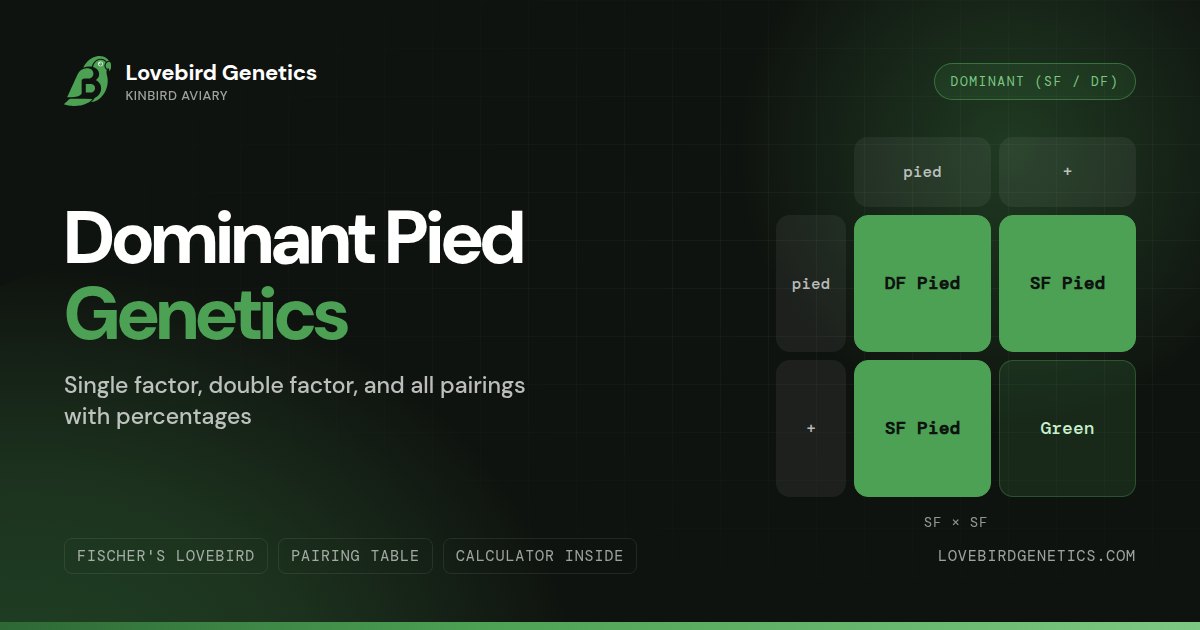
Dominant Pied in Fischer's lovebirds is autosomal dominant. Melanin is absent from irregular patches of feathering, so those patches appear yellow on a green series bird and white on a blue series bird, against normally coloured plumage everywhere else. One copy already shows. That means there is no split form at all: a bird either shows pied markings or does not carry the gene. Zygosity still matters. A single factor bird passes the gene to about half its chicks. A double factor bird passes a copy to every chick, so it produces one hundred percent pied chicks against any partner. SF and DF are hard to separate by eye, so you identify a double factor bird from breeding results, not from pattern. Because the gene is autosomal, reversing a pairing changes nothing. The mutation people confuse it with is a different gene entirely: Recessive Pied lovebird genetics works the opposite way, needing two copies and hiding completely in a split. Our calculator models Dominant Pied as trait DomPied with SF and DF statuses, and Recessive Pied separately.
A pied mutation is not a colour mutation in the ordinary sense. Most mutations change the amount or the type of pigment across the whole bird evenly, which is why a Dilute or a Pastel looks like a lighter version of itself from head to tail. A pied mutation does something different: it prevents melanin from being deposited at all in certain feather-forming areas, while leaving the rest of the plumage untouched. Because the instruction affects where pigment is laid down rather than how much, the same genotype can produce visibly different patterns in different individuals (Van den Abeele, Lovebird Compendium, 2016).
What is a Dominant Pied lovebird?
A Dominant Pied lovebird carries at least one copy of an autosomal dominant mutation that stops melanin forming in irregular patches. Those clear patches appear yellow on green series birds and white on blue series birds. One copy is already enough, so no split form exists.
Every normally coloured Fischer's lovebird lays down eumelanin, the dark pigment that supplies depth and structure in the feather, alongside the psittacine pigments that supply yellow and orange. Where both are present on a green bird, the eye reads green. Remove the eumelanin from a patch of that bird and the underlying psittacine yellow is all that remains in that patch, so it reads yellow. Do the same on a blue series bird, which carries no psittacine yellow to begin with, and the patch has nothing left to show at all, so it reads white.
That single mechanism explains everything you see on a Dominant Pied bird:
- Dominant Pied Green shows yellow patches against green. High contrast, unmistakable across a flight cage.
- Dominant Pied Blue 1 and Blue 2 show white patches against blue. Again high contrast, and on a well marked bird the clear areas can be striking.
- Dominant Pied Aqua B1, Aqua B2 and Aqua Homo show clear areas reading as pale cream or off-white, because the aqua series carries a partial amount of psittacine yellow depending on grade.
- Dominant Pied Parblue gives the least contrast, because a parblue bird already carries a strong yellow expression across the body, so the clear patches sit close in tone to the coloured areas.
The beak and the eyes are not part of the pied mechanism. Dominant Pied birds have normal dark eyes at every age, with no red or plum reflection under a torch, which immediately separates even a heavily marked pied from any ino-type bird. There is no viability concern attached to the mutation either, and unlike recessives such as Bronze Fallow, pairing two visuals carries no known mortality risk.
Dominant Pied does not dilute the bird, does not soften it and does not change the colour of the areas it leaves alone. A coloured patch on a Dominant Pied Green is exactly as green as a normal green bird, and a clear patch has no melanin at all. There is no in-between. That all-or-nothing quality per feather area is what separates a pied from a dilution mutation, and it is the fastest visual check you can make on a bird you have never seen before.
Where the clear areas land is not fixed. Some birds carry most of it across the nape, some on the flights and the shoulder, some in a broad band across the abdomen. Two Dominant Pied siblings from the same nest carrying the same genotype can look substantially different from each other. That variability is normal, it is not a genetic status, and it is the single biggest reason zygosity has to be established by breeding rather than by eye.
The word "pied" on a leg-ring card is also not a genetic statement. It describes an appearance shared by at least three situations in Agapornis fischeri: Dominant Pied, the separate autosomal recessive covered in Recessive Pied lovebird genetics, and the multi factorial mottle discussed near the end of this page.
How does Dominant Pied inherit in lovebirds?
Dominant Pied is autosomal dominant. A single copy already produces visible pied markings, so there is no split form and the gene cannot hide in a line. Because it is autosomal rather than sex-linked, reversing a pairing never changes the outcome for either sex.
Autosomal means the gene sits on an ordinary chromosome rather than a sex chromosome. In birds, cocks are ZZ and hens are ZW, so a sex-linked mutation such as Opaline or Cinnamon sits on the Z, and hens can never be split for one. Dominant Pied is on an autosome, and both sexes carry two copies of every autosome, so both sexes have exactly the same possible states. Dominant means one copy is enough to produce the visible effect. Combine the two words and you get a mutation with only three possible genotypes and two possible appearances:
- Single factor Dominant Pied (SF). One Dominant Pied allele plus one normal allele. The bird shows pied markings. It passes the mutation to about half its chicks.
- Double factor Dominant Pied (DF). Two Dominant Pied alleles and no normal allele at all. The bird shows pied markings. It passes a copy to every single chick it produces, without exception.
- Normal. No Dominant Pied allele at all. Shows nothing and can contribute nothing to any chick.
Notice what is missing from that list. There is no fourth state, no carrier, no hidden copy, no split. This is the single most important practical difference between this mutation and its recessive namesake.
A split means one copy of a mutation that produces no visible effect. Dominant Pied produces a visible effect from a single copy, so the concept does not apply to it at all. If a bird is offered to you as "split Dominant Pied", one of two things is true: the description is wrong, or the bird is actually split for the separate recessive gene described in the Recessive Pied guide, which does have a genuine invisible split form.
The consequences of no split form run through everything a breeder does with this mutation, and they are almost all good news:
- The gene cannot skip a generation. Every Dominant Pied bird has at least one Dominant Pied parent. A pied chick from two unmarked parents is therefore never Dominant Pied, and is almost always Recessive Pied from two carriers.
- Nothing needs test pairing to establish presence. With a recessive you spend seasons hunting hidden carriers. Here presence is written on the bird, and only zygosity ever needs testing.
- The mutation is easy to remove from a line. Not breeding from pied-marked birds removes the gene completely in one generation, because no unmarked bird carries it.
- Reversing the pairing changes nothing. Every table on this page is direction-independent. With sex-linked mutations the reversal produces a completely different result and in one direction the chicks even sex themselves in the nest.
If the vocabulary around carriers is new, the guide on what a split lovebird is works the concept through from the ground up. Understanding what a split is makes it obvious why Dominant Pied cannot have one.
We treat every incoming pied bird as an unknown until the paperwork or a clutch says otherwise. A pied bird from a market tells you it has pied markings and nothing else. It does not tell you whether those markings come from one dominant copy, two dominant copies, or two recessive copies. Our record card carries three separate lines for a pied bird: what the bird shows, what the seller claimed, and what we have confirmed from a pairing. Merging those three lines is how a pied line quietly goes wrong.
What is the difference between single factor and double factor Dominant Pied?
Single factor means one copy, double factor means two. Both show pied markings and both are hard to separate by eye. The real difference is what they pass on: a single factor bird gives the mutation to about half its chicks, a double factor bird gives it to every chick.
Zygosity is the word for how many copies of an allele a bird carries. With a recessive mutation, zygosity decides whether the bird shows the mutation at all, so it is obvious from appearance. With a dominant mutation, one copy is already enough to show, so zygosity decides something different: how reliably the mutation is passed on. A bird passes one allele from each pair to each chick, chosen at random:
- A single factor bird carries one Dominant Pied allele and one normal allele. Each chick has a fifty percent chance of receiving the Dominant Pied allele, so roughly half its chicks show pied markings and roughly half do not.
- A double factor bird carries two Dominant Pied alleles and no normal allele. Whichever one is chosen, it is a Dominant Pied allele. Every chick receives one, without exception, and every chick therefore shows pied markings.
That is the whole of it. A double factor bird is not a "stronger" pied in any genetic sense that matters at the locus. It is a bird that cannot produce a normal chick.
| Single factor (SF) | Double factor (DF) | |
|---|---|---|
| Copies of the mutation | One | Two |
| Does it show? | Yes | Yes |
| Passes mutation to | About 50% of chicks | 100% of chicks, always |
| Can produce a normal chick? | Yes, against a normal partner about half the nest | Never, against any partner |
| Paired to a normal bird gives | 50% SF pied, 50% normal | 100% SF pied, no normals |
| Reliable to tell by eye? | No | No |
| How you confirm it | A single normal chick from a normal partner proves SF | Every chick pied across several clutches indicates DF |
| Calculator status | SF | DF |
Both birds look pied. The difference lives entirely in what comes out of the nest, which is why zygosity is a breeding record rather than an observation.
A common question at this point is whether a double factor bird looks more heavily marked than a single factor one. The tendency is often reported, and a double factor bird does frequently carry more clear feathering, but it is not reliable for an individual bird. The pattern is variable enough that a heavily marked single factor bird and a lightly marked double factor bird both exist and are not unusual. Anyone selecting stock on pattern alone will eventually be wrong.
The amount of clear feathering on a Dominant Pied bird is not a reliable indicator of whether it carries one copy or two. Pattern varies between individuals with the same genotype, and within a single clutch. A bird called double factor purely because it is heavily marked has not been established as double factor at all. The claim only becomes real once several clutches against a normal partner have produced no normal chick. Until then, record it as single factor, because that is the assumption that fails safely.
Single factor and double factor are the same terms used for the other dominant mutations in the species. Fischer's lovebirds also carry incomplete dominants where SF and DF birds look visibly different from each other, and the guide on Euwing, Greywing and Misty works through those. Dominant Pied is not incomplete dominant in that visually obvious way, which is exactly why it needs the breeding test described next.
How do you identify a double factor Dominant Pied bird?
By its breeding results, not by its appearance. Pair the bird to a plain normal partner. A double factor bird cannot produce a normal chick, so if every chick is pied across multiple clutches, it is almost certainly double factor. One normal chick proves single factor instantly.
The test is the simplest one in lovebird genetics, because the two possible answers give completely different clutches against the same partner. Pair the pied bird to a normal bird with no pied ancestry at all, and then just count:
- If the bird is single factor, about half the chicks show pied markings and about half are plain normal. Any normal chick at all settles the question immediately and permanently.
- If the bird is double factor, every single chick shows pied markings, and a normal chick is genetically impossible. Not unlikely, impossible.
The asymmetry is what makes the test practical. One normal chick is proof of single factor. A run of pied chicks is never proof of double factor, it only makes single factor progressively less likely, because a single factor bird can produce a run of pied chicks by chance. Each pied chick halves the remaining probability that the bird was single factor.
| Pied chicks in a row, no normals | Chance the parent is still single factor | What to record |
|---|---|---|
| 1 | 50% | Nothing proved yet |
| 2 | 25% | Still an open question |
| 3 | 12.5% | Leaning towards double factor |
| 4 | 6.3% | Probably double factor |
| 5 | 3.1% | Working assumption: double factor |
| 6 | 1.6% | Treat as double factor, note the basis |
| 8 or more | <0.5% | Double factor for all practical purposes |
A single normal chick at any point ends the test and proves single factor. The table only applies while every chick has been pied.
Two details make the test trustworthy, and skipping either of them wastes the season:
The test partner must be genuinely normal. A plain bird with no pied ancestry, no pied siblings, and ideally no pied birds anywhere in its recorded line. If the partner happens to be split for the recessive pied gene, some chicks may show recessive pied markings, and you will count those as evidence about the dominant gene when they are nothing of the sort.
Count across clutches, not within one. A clutch of four can easily be four pied chicks from a single factor parent by chance alone, which is a one in sixteen result and happens regularly across an aviary. Two or three clutches with no normal chick carries real weight. One clutch carries very little.
We ran this test twice on birds sold to us as double factor. One produced a normal chick in its first clutch, and the card was corrected to single factor that morning. The other went three clutches with eleven chicks and no normals, which we now treat as double factor with the basis written on the card. The wording matters. The card says "DF, indicated by 11 pied chicks, no normals, 3 clutches, normal partner", not simply "DF". Anyone reading that card later can see exactly how strong the claim is.
One shortcut is worth knowing. If the bird's own parents are recorded, the answer sometimes falls out without a test at all. A pied bird from one pied parent and one normal parent can only be single factor, because the normal parent could only contribute a normal allele. A bird can only be double factor if both its parents showed pied markings. That single pedigree check eliminates a great many test pairings before they start.
Dominant Pied pairing outcomes, cock × hen
Six pairings cover every Dominant Pied decision. Because Dominant Pied is autosomal, every outcome below applies equally to cocks and hens, and swapping the cock and the hen changes nothing at all. That is the opposite of a sex-linked mutation such as Opaline, where the direction of the cross decides the result.
Read every table as a percentage per chick, not a guarantee per clutch. A fifty percent outcome means each chick has a one in two chance of being that type, so a clutch of four can easily contain no pied chick at all, or four of them. The only rows here that are true guarantees are the hundred percent rows, and those hold because the parent genuinely has no other allele to give.
Single factor Dominant Pied cock × normal hen
Fifty percent single factor Dominant Pied and fifty percent completely normal chicks, evenly across both sexes. The single factor parent passes its dominant allele to half its chicks on average, and every chick that receives it shows the pattern. No double factor chick is possible, and no hidden carrier is produced.
| Offspring | Percentage | Sex | Notes |
|---|---|---|---|
| Single factor Dominant Pied | 50% | Cocks and hens | Shows pied markings. Carries one dominant copy and one normal copy |
| Normal | 50% | Cocks and hens | Carries nothing. Not a split, because no split form exists for this gene |
| Double factor Dominant Pied | 0% | Neither sex | Impossible. The normal parent contributes a normal allele to every chick |
The normal chicks in this nest carry nothing at all and can be sold or paired as plain birds with no pied risk attached.
→ Run this pairing in the calculatorSingle factor Dominant Pied cock × single factor Dominant Pied hen
Twenty five percent double factor, fifty percent single factor and twenty five percent normal, evenly across both sexes. Seventy five percent of the nest shows pied markings. This is the only pairing on the page that produces double factor chicks from single factor parents, and the double factor chicks cannot be identified by eye.
| Offspring | Percentage | Sex | Notes |
|---|---|---|---|
| Double factor Dominant Pied | 25% | Cocks and hens | Two dominant copies. Will give 100% pied chicks against anything. Not identifiable by eye |
| Single factor Dominant Pied | 50% | Cocks and hens | Shows pied markings. Indistinguishable from the double factor chicks without a test pairing |
| Normal | 25% | Cocks and hens | No dominant allele at all. Carries nothing forward |
Any pied chick from this nest has a one in three chance of being double factor, which is a probability, not a status. Record it as such until a test pairing settles it.
→ Run this pairing in the calculatorDouble factor Dominant Pied cock × normal hen
One hundred percent single factor Dominant Pied chicks, in both sexes. No normal chick is possible here. The double factor parent carries no normal allele and so passes a dominant copy to every chick, while the normal parent passes a normal allele to every chick, making the whole nest single factor.
| Offspring | Percentage | Sex | Notes |
|---|---|---|---|
| Single factor Dominant Pied | 100% | Cocks and hens | Every chick shows pied markings and carries exactly one dominant copy |
| Normal | 0% | Neither sex | Impossible. The double factor parent has no normal allele to give |
| Double factor Dominant Pied | 0% | Neither sex | Impossible. The normal parent has no dominant allele to give |
This is also the diagnostic pairing. A run of clutches with no normal chick at all is exactly the evidence that identifies a double factor parent.
→ Run this pairing in the calculatorDouble factor Dominant Pied cock × single factor Dominant Pied hen
Fifty percent double factor and fifty percent single factor, in both sexes. Every chick shows pied markings, because the double factor parent contributes a dominant allele to all of them. No normal chick is possible, and the two chick types cannot be separated by eye.
| Offspring | Percentage | Sex | Notes |
|---|---|---|---|
| Double factor Dominant Pied | 50% | Cocks and hens | Received a dominant allele from each parent |
| Single factor Dominant Pied | 50% | Cocks and hens | Received a dominant allele from the DF parent and a normal one from the SF parent |
| Normal | 0% | Neither sex | Impossible. The double factor parent contributes a dominant allele to every chick |
Every chick is pied and every chick has a one in two chance of being double factor. This is the fastest way to build a group of likely double factor birds from a single confirmed one.
→ Run this pairing in the calculatorDouble factor Dominant Pied cock × double factor Dominant Pied hen
One hundred percent double factor Dominant Pied chicks, in both sexes. Neither parent carries a normal allele, so every chick receives two dominant copies. This pairing breeds absolutely true and nothing in the nest requires testing afterwards, which makes it the endpoint of any Dominant Pied plan.
| Offspring | Percentage | Sex | Notes |
|---|---|---|---|
| Double factor Dominant Pied | 100% | Cocks and hens | Breeds true. Every chick will itself give 100% pied chicks against any partner |
| Single factor Dominant Pied | 0% | Neither sex | Impossible. Neither parent has a normal allele to give |
| Normal | 0% | Neither sex | Impossible for the same reason |
Every chick is double factor, but the amount of clear feathering each one carries is still not predictable from the parents.
→ Run this pairing in the calculatorDominant Pied cock × Recessive Pied hen
These are different genes at different loci, so the chicks inherit them independently. About fifty percent of the chicks show Dominant Pied markings if the dominant parent is single factor, and every chick without exception is split for Recessive Pied. No chick is a visual Recessive Pied, because the dominant parent contributes a normal allele at the recessive locus.
| Offspring | Percentage | Sex | Notes |
|---|---|---|---|
| Dominant Pied, split Recessive Pied | 50% | Cocks and hens | Shows pied markings from the dominant gene only. Also carries one hidden Recessive Pied allele |
| Normal-looking, split Recessive Pied | 50% | Cocks and hens | Did not receive the dominant allele. Looks plain, carries one hidden Recessive Pied allele |
| Visual Recessive Pied | 0% | Neither sex | Impossible here. The Dominant Pied parent contributes a normal allele at the Recessive Pied locus |
Every chick in this nest is split for Recessive Pied, whether it looks pied or not. If the Dominant Pied parent is double factor instead, one hundred percent of the chicks show Dominant Pied and one hundred percent are still split for Recessive Pied. The recessive side of this cross is worked through in full in Recessive Pied lovebird genetics.
→ Run this pairing in the calculatorEvery pairing above gives the identical result when you swap the cock and the hen. A double factor Dominant Pied cock over a normal hen and a normal cock over a double factor Dominant Pied hen both give one hundred percent single factor pied chicks. That is the practical signature of an autosomal gene. With Opaline or Cinnamon, reversing the pairing changes the answer completely and in one direction the chicks even sex themselves in the nest.
Run your own Dominant Pied pairing in seconds
Dominant Pied and Recessive Pied modelled separately, across every base colourOne summary table pulls all six together, which is useful when planning a season rather than a single nest.
| Pairing (direction irrelevant) | DF chicks | SF chicks | Normal chicks |
|---|---|---|---|
| SF × normal | 0% | 50% | 50% |
| SF × SF | 25% | 50% | 25% |
| DF × normal | 0% | 100% | 0% |
| DF × SF | 50% | 50% | 0% |
| DF × DF | 100% | 0% | 0% |
| SF × Recessive Pied visual | 0% | 50% | 50% |
In the last row every chick is additionally split for Recessive Pied, and the "normal chicks" column means normal at the dominant locus only. The wider set of engine-verified crosses lives in the lovebird pairing outcomes hub.
What is the difference between Dominant Pied and Recessive Pied?
They are different genes at different loci. Dominant Pied is autosomal dominant, shows with a single copy, and has no split form at all. Recessive Pied is autosomal recessive, needs two copies, and hides completely in an invisible split. They do not substitute for each other.
This is the section that matters most, because it is where the majority of pied confusion in the hobby lives. Fischer's lovebirds have two independent pied systems, and both produce clear patches of feathering that a photograph cannot tell apart. Everything else about them is opposite, and the full recessive side is documented in Recessive Pied lovebird genetics.
Dominant Pied needs one copy. A single dominant allele already produces visible markings, which means there is no such thing as a split Dominant Pied. The mutation cannot hide. If a bird carries it, the bird shows it. Every Dominant Pied bird therefore has at least one Dominant Pied parent, the gene can never skip a generation, and a pied chick out of two unmarked parents is never Dominant Pied.
Recessive Pied needs two copies. One copy does nothing visible at all. The mutation can travel through a line for generations without a single pied bird appearing, hiding in split after split, until two carriers happen to be paired and a pied chick arrives apparently out of nowhere. Breeders who have never bought a pied bird sometimes produce one, and the explanation is always the same: two of their birds were splits. That behaviour is impossible for Dominant Pied and is the clearest structural difference between the two, worked through in detail in the Recessive Pied guide.
Because they are separate genes at separate loci, they are inherited independently. A bird can carry both, a visual Dominant Pied that is also split for Recessive Pied looks exactly like one carrying nothing extra, and pairing the two does not combine them into a stronger pied. Each gene simply follows its own rules in each chick, which is what the cross table above shows.
You cannot identify the pied system from appearance. A bird showing pied markings is either carrying at least one Dominant Pied copy or two Recessive Pied copies, and no amount of studying the pattern separates those two possibilities reliably. Only pedigree or a test pairing settles it. For a pied bird with no verified parentage the honest entry on the card is "pied, system unknown", and the first thing to plan is the pairing that resolves it.
The resolving test is the same one described earlier. Pair the unknown pied bird to a plain normal bird with no pied ancestry and read the clutch:
- Roughly half the chicks pied: the parent was a single factor Dominant Pied.
- Every chick pied: most likely a double factor Dominant Pied. Confirm across more than one clutch.
- No chick pied at all: the parent was a visual Recessive Pied. Every chick received one recessive copy from it and one normal copy from the other parent, so the whole clutch is split and none of them show anything. This is the clearest single result in the entire pied question.
One clutch usually answers the dominant against recessive question, even if it takes two or three to settle zygosity. That is why this article and the Recessive Pied guide are written as a pair. The two mutations share a name and nothing else.
| Dominant Pied | Recessive Pied | |
|---|---|---|
| Inheritance mode | Autosomal dominant | Autosomal recessive |
| Gene and locus | Its own locus | A different locus, inherited independently |
| Copies needed to show | One | Two |
| Is there a split form? | No, a carrier always shows | Yes, and it is completely invisible |
| Can it hide in a line? | No, never | Yes, indefinitely |
| Can it skip a generation? | No, every pied bird has a pied parent | Yes, easily and often |
| Zygosity matters? | Yes, SF against DF changes what it passes on | Only in the sense of visual against split |
| Can hens carry it hidden? | No split form exists for either sex | Yes, exactly as cocks can |
| Does reversing the pairing matter? | No | No |
| Calculator statuses | SF, DF | Visual, Split |
| Calculator trait id | DomPied | RecPied |
| Full guide | This page | Recessive Pied lovebird genetics |
Two separate genes producing a superficially similar pattern. They do not substitute for each other and they do not combine into a single stronger pied.
There is a practical consequence worth stating on its own. Dominant Pied is a mutation you can see, so a line built on it is readable at a glance and mistakes surface within one generation. A recessive pied line is the opposite: most of the gene in the aviary is invisible at any moment, and the plan lives on paper rather than in the cage. Neither is better, but they demand completely different record keeping.
What about Mottle or progressive pied?
Mottle is a separate thing again. Ornitho-Genetics VZW lists mottle in MutaBase as autosomal multi factorial, and its defining feature is that the pied area increases with every moult. Because several genes influence it, no calculator can give fixed percentages, so ours does not model it.
Mottle, often called progressive pied, is the third pattern filed under "pied" in the hobby, and it behaves unlike either of the other two. A mottled bird may carry almost no clear feathering as a youngster and become progressively more marked as it moults through successive years. The change is gradual and continues over several moults, which is where the word progressive comes from. A Dominant Pied bird does not do this. Its pattern is set from the first full feathering and stays broadly stable through life.
The genetics behind that behaviour are why mottle sits outside the calculator. Ornitho-Genetics VZW records mottle in its MutaBase entry for mottle as autosomal multi factorial, meaning the trait is influenced by more than one gene rather than by a single locus with clean dominant or recessive behaviour. That has three consequences for a breeder:
- There is no fixed percentage. A single-gene dominant gives clean fifty, seventy five and one hundred percent outcomes. A multi factorial trait does not, because the result depends on how many contributing genes each chick inherits.
- Single factor and double factor do not apply. The SF and DF vocabulary describes zygosity at one locus. It does not map onto a trait spread across several genes, so calling a mottled bird "double factor" is not a meaningful statement.
- The phenotype changes with age. Any assessment of a mottled bird is a snapshot, so a record made at six months is not a description of the adult, and a bird judged lightly marked as a youngster may be extensively marked three moults later.
Because of all three, our calculator does not model mottle, and we would treat any calculator offering confident mottle percentages with suspicion. Dominant Pied, by contrast, is a clean single-gene autosomal dominant, which is exactly why it can be modelled precisely and why every table on this page is exact.
Dominant Pied: one gene, autosomal dominant, one copy shows, no splits exist, SF and DF zygosity, modelled by the calculator. Recessive Pied: a different gene, autosomal recessive, two copies to show, invisible splits exist, also modelled. Mottle: autosomal multi factorial per Ornitho-Genetics VZW, pied area increases with each moult, no fixed percentages possible, not modelled. Three names, three genetic systems, one shared appearance.
If you are working through the full mutation landscape rather than just the pied group, the Fischer's lovebird mutations hub lists every documented mutation alongside its inheritance mode, which is the fastest way to see where the two pied genes sit relative to everything else in the species.
How does the calculator handle Dominant Pied?
As a true autosomal dominant with SF and DF statuses. Dominant Pied is trait id DomPied, offering Single Factor and Double Factor rather than Visual and Split, because a dominant mutation has no split form. Recessive Pied is a separate trait, RecPied, with Visual and Split.
Keeping the two pied genes separate in the engine sounds obvious and is exactly what several tools get wrong. A calculator offering a single "Pied" trait cannot produce correct answers, because the two genes give opposite results from identical-looking parents. Offering "split" as a status for a dominant mutation is the same error in a different form. Our Lovebird Genetics Calculator models the two genes independently and gives each one only the statuses that genuinely exist for it.
What that means when you use it:
- Dominant Pied appears under Dominant, with SF and DF statuses for either parent. There is no Split option, deliberately, because selecting one would describe a bird that cannot exist.
- Selecting DF on one parent returns one hundred percent pied chicks, whatever the other parent is. That is not an approximation, it is a structural certainty of the mutation.
- Recessive Pied appears under Autosomal Recessive, with Visual and Split statuses, exactly like Dilute, Pale Fallow and Dun Fallow.
- Both can be selected on the same bird, because they occupy separate loci and are inherited independently, which is how the Dominant Pied by Recessive Pied cross above is generated.
- Pattern amount is never predicted. The engine returns the genotype and the visual category, not how much clear feathering a chick will show, because no honest engine can predict that.
If the interface is new to you, the step-by-step walkthrough covers entering each parent and reading the results panel. For the underlying concepts, lovebird colour genetics explains eumelanin, psittacine pigment and the four inheritance modes, and the complete lovebird genetics guide ties every mutation group together. For other dominant mutations that use the same SF and DF vocabulary, see Euwing, Greywing and Misty. And for pied specifically, this article and Recessive Pied lovebird genetics are designed to be read together, because almost every real pied question in an aviary is a question about which of the two genes is present.
The reference material behind all of this is public. Ornitho-Genetics VZW maintains MutaBase, the database recording the inheritance classification of each named mutation across parrot species, and publishes its research through ogvzw.org. The base reference for everything on this page is Dirk Van den Abeele's Lovebird Compendium (2016).
References
- Van den Abeele, D. (2016). Lovebird Compendium. Ornitho-Media. ISBN 978-90-822990-0-3. (Base reference: pattern mutations, melanin deposition, autosomal dominant inheritance and single factor against double factor zygosity in Agapornis.)
- Ornitho-Genetics VZW. MutaBase mutation database. Accessed 2026. (Inheritance classification of the dominant and recessive pied mutations.)
- Ornitho-Genetics VZW. MutaBase entry: Mottle. Accessed 2026. (Mottle classified as autosomal multi factorial, pied area increasing with each moult.)
- Ornitho-Genetics VZW. Research and publications of the MUTAVI Research & Advice Group.
- KinBird Aviary engine notes (2026). DomPied SF and DF implementation in the Lovebird Genetics Calculator, verified against the Compendium's inheritance model.
Frequently asked questions
What is a Dominant Pied lovebird?
A Dominant Pied lovebird is a Fischer's lovebird carrying at least one copy of an autosomal dominant mutation that stops melanin being deposited in irregular patches of feathering. Those clear patches read yellow on a green series bird and white on a blue series bird, while the rest of the plumage keeps its normal colour. Because the mutation is dominant, a single copy is already enough for the pattern to show, so there is no split Dominant Pied. A bird either shows the pattern or does not carry the gene at all.
Is Dominant Pied in lovebirds dominant or recessive?
Dominant Pied is autosomal dominant. It sits on an ordinary chromosome rather than the Z sex chromosome, and one copy is enough for the bird to show pied markings. That combination has two direct consequences. First, there is no split form, so the gene cannot travel invisibly through a line the way an autosomal recessive can. Second, because it is autosomal rather than sex-linked, swapping the cock and the hen never changes the outcome of a pairing.
What do you get from a single factor Dominant Pied cock x normal hen?
Fifty percent single factor Dominant Pied and fifty percent completely normal chicks, spread evenly across both sexes. The single factor parent carries one dominant allele and one normal allele, so it passes the dominant allele to half its chicks on average. Every chick that receives it shows pied markings, and every chick that does not is a plain bird carrying nothing. No double factor chick is possible from this pairing, and no hidden carrier is produced.
What do you get from a double factor Dominant Pied cock x normal hen?
One hundred percent single factor Dominant Pied chicks, in both sexes. A double factor bird carries two dominant alleles and has no normal allele to give, so every chick receives one dominant copy and shows pied markings. No normal chick is possible from this pairing, and no double factor chick is possible either, because the normal parent contributes a normal allele to every chick. A run of clutches with no normal chick at all is the standard evidence that a bird is double factor.
What do you get from a double factor Dominant Pied cock x double factor Dominant Pied hen?
One hundred percent double factor Dominant Pied chicks, in both sexes. Neither parent carries a normal allele, so every chick receives a dominant allele from each side and is double factor itself. This pairing breeds absolutely true, every chick shows pied markings, and every chick will in turn produce one hundred percent pied chicks against any partner. The amount of clear feathering on each chick still varies, because the gene controls where pigment is switched off rather than how much appears.
What is the difference between single factor and double factor Dominant Pied?
Single factor means one dominant allele plus one normal allele. Double factor means two dominant alleles. Both birds show pied markings, and the two are hard to separate by eye because the amount of clear feathering varies between individuals regardless of zygosity. The reliable difference is in the breeding results. A single factor bird passes the mutation to about half its chicks, so paired to a normal bird it produces roughly half pied and half normal. A double factor bird passes a copy to every chick, so paired to a normal bird it produces one hundred percent pied chicks and never a normal one.
How do you identify a double factor Dominant Pied bird?
By its breeding results rather than its appearance. Pair the bird to a plain normal partner with no pied ancestry and count the chicks over several clutches. A double factor bird cannot produce a normal chick, so if every single chick shows pied markings across multiple clutches the bird is almost certainly double factor. A single normal chick at any point proves the bird is single factor and ends the question immediately. Appearance is not reliable, because a heavily marked single factor bird and a lightly marked double factor bird both exist.
What is the difference between Dominant Pied and Recessive Pied?
They are different genes at different loci, inherited in opposite ways. Dominant Pied is autosomal dominant: a single copy already shows, so there is no split form and the mutation can never hide in a line. Recessive Pied is autosomal recessive: two copies are needed before any pied marking appears, and a single copy hides completely, so a split Recessive Pied looks like an ordinary bird. The two genes do not substitute for each other and pairing them does not combine into a stronger pied. A pied-marked bird carries either at least one dominant copy or two recessive copies, and only pedigree or a test pairing tells you which. The full recessive breakdown is in our Recessive Pied lovebird genetics guide.
Can a Dominant Pied lovebird be split?
No. A split means one copy of a mutation that produces no visible effect, and Dominant Pied produces a visible effect from a single copy. A bird therefore either shows Dominant Pied markings or does not carry the gene at all. Any bird described as split for Dominant Pied is either mislabelled, or is actually split for Recessive Pied, which is a completely separate gene that does have a genuine invisible split form.
Is Mottle the same as Dominant Pied in lovebirds?
No. Mottle, sometimes called progressive pied, is a separate thing again. Ornitho-Genetics VZW lists mottle in its MutaBase database as autosomal multi factorial rather than a single dominant or recessive gene, and its defining feature is that the pied area increases with each moult. Because several genes influence how much clear area appears, no calculator can give fixed percentages for mottle, and ours does not model it. Dominant Pied is a single autosomal dominant gene with a pattern set from the first full feathering.